Education in the Age of Intelligence: Present and Future Skills Society Actually Needs

A narrative review and policy-oriented framework for vocational resilience, immersive education, and labor-market alignment (2024–2025 evidence)

Abstract

Public discourse on artificial intelligence (AI) and work often centers on job displacement and the future value of technical skills. However, recent European and global evidence indicates that many labor-market pressures stem less from automation than from persistent shortages in essential, vocation-driven professions (e.g., healthcare, education, engineering) and from skills mismatches.

This article synthesizes 2024–2025 evidence from the European Commission, Eurostat, the European Parliament, the OECD, Eurofound, the World Health Organization, and the World Economic Forum to (1) quantify demand signals in critical sectors, (2) distinguish “future skills” from “enduring societal skills,” and (3) propose immersive, experience-based education as a scalable mechanism to surface latent vocations and improve education-to-work transitions.

We argue that the most strategic response to AI-era disruption is not solely reskilling for technology, but redesigning education to cultivate vocational identity, ethical judgment, and systems thinking—capabilities that strengthen societal resilience across demographic change, healthcare strain, and infrastructure transitions.

Keywords: Artificial intelligence, workforce shortages, vocational education, immersive learning, XR, teacher shortages, healthcare workforce, skills mismatch, EU labor market, future of work.

1. Introduction

AI is accelerating task automation and reshaping occupational content. Yet the policy-relevant question is no longer only “which jobs will disappear,” but “which roles must reliably be staffed for society to function.” In the European Union (EU), labor and skills shortages are reported across all Member States, with employers indicating difficulty filling roles and the Commission identifying EU-wide shortage occupations.

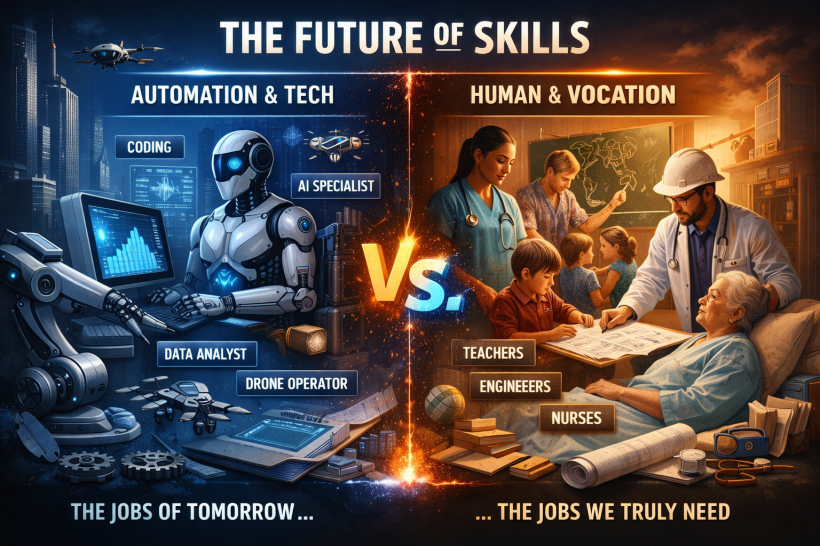
This reframes “future skills” as a dual challenge: (a) technology fluency and adaptation, and (b) the cultivation of vocation-driven professions (health, education, engineering) where the binding constraint is often labor supply, working conditions, and training pathways rather than automation.


2. Method

This paper uses a narrative review approach, prioritizing 2024–2025 institutional sources and official statistical reporting: European Commission policy releases; Eurostat labor indicators; European Parliament briefings; OECD Education at a Glance 2024; Eurofound EWCS 2024 first findings; WHO workforce projections; and WEF Future of Jobs 2025. The goal is integrative synthesis (not meta-analysis), linking labor-demand signals to education design principles.


3. Evidence: Demand Signals and Skills Mismatches in Europe and Globally

3.1 EU-wide labor and skills shortages (systemic, not marginal)

The European Commission reports shortages rising across all Member States, noting that 63% of SMEs in a cited survey cannot find the talent they need and that the Commission has identified 42 shortage occupations.
This indicates structural mismatches: vacancies persist even where overall employment is high.

3.2 Job vacancies as a measurable pressure indicator (Eurostat)

Eurostat’s job vacancy statistics provide the harmonized framework for tracking labor-market tightness and the distribution of vacancy pressures across sectors and time.
Eurostat’s euro indicators also report vacancy rates by economic activity (EU and euro area), supporting sector-level interpretation (e.g., where shortages concentrate).

3.3 Healthcare: the clearest case of “enduring societal demand”

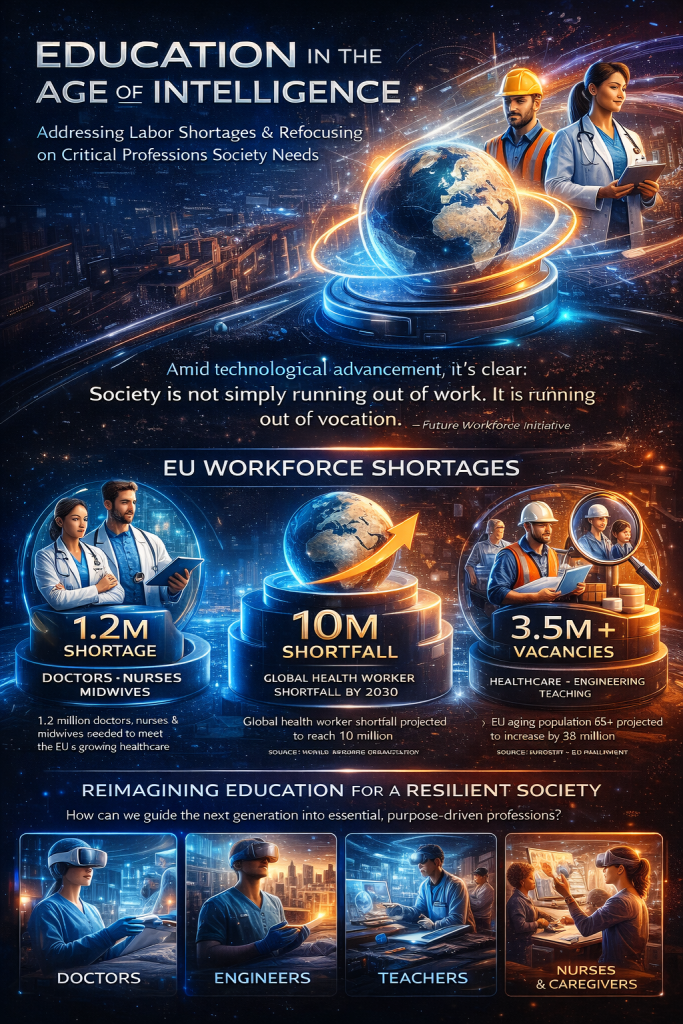
EU health workforce shortages have been estimated at ~1.2 million doctors, nurses and midwives (as of 2022) in a European Parliament briefing referencing Health at a Glance: Europe 2024.
Globally, WHO reporting to its governing bodies indicates a projected shortage of ~11.1 million health workers by 2030 (with regional variation).
Complementary 2025 analysis also frames the expected global shortage as at least 10 million by 2030, emphasizing macroeconomic and health-burden implications.
Taken together, these sources support a robust range: ~10–11 million global shortfall by 2030, with the EU facing acute shortages as well.

3.4 Education: teacher shortages and system capacity

OECD’s Education at a Glance 2024 documents teacher workforce conditions and explicitly addresses where countries stand regarding shortages.
This matters because education systems are the pipeline for healthcare, engineering, and scientific capacity; teacher shortages can become a compounding constraint on future workforce supply.

3.5 Working conditions and retention: the “hidden” skills crisis

Eurofound’s EWCS 2024 first findings provide EU-wide evidence on job quality and working conditions—factors that strongly influence recruitment and retention in shortage sectors (notably health and care).
In practice, shortages often reflect not only training capacity, but also job quality, emotional demands, and sustainability of working lives.


4. Reframing the Skills Debate: “Future Skills” vs. “Enduring Societal Skills”

4.1 What employers say is rising (WEF 2025)

WEF’s Future of Jobs Report 2025 identifies skills increasing in importance through 2030, including AI and big data, analytical thinking, creative thinking, resilience/flexibility/agility, and technological literacy.
Notably, the “future skills” list is not purely technical; it elevates cognitive and socio-emotional capabilities.

4.2 Enduring societal skills (a functional definition)

This paper proposes “enduring societal skills” as capabilities that sustain essential services under demographic pressure, infrastructure transition, and systemic shocks:

  • Clinical judgment, empathy, ethical decision-making (health and care)
  • Pedagogy, mentorship, relational intelligence (education)
  • Systems thinking, safety culture, design responsibility (engineering/infrastructure)
  • Scientific reasoning, experimentation, uncertainty handling (research and innovation)

These are vocation-linked and inherently shaped by practice, context, and responsibility.


5. Why Immersive Education is Strategically Relevant

If the binding constraint is vocational supply and sustained motivation, education must support vocational discovery earlier and more vividly than traditional abstract instruction.

Immersive (XR) education can:

  1. Reduce abstraction by allowing learners to “enter” professional contexts (e.g., clinical simulations, engineering systems, lab environments).
  2. Strengthen vocational identity through situated experience (students can test-fit roles before commitment).
  3. Improve skills transfer by training perception-action loops (procedural and spatial reasoning), complementing conceptual learning.
  4. Support equity of access by bringing high-cost environments (operating rooms, labs) into schools.

Crucially, immersive learning should not be positioned as replacing teachers, but as increasing the bandwidth of teaching—especially relevant when teacher shortages strain system capacity.


6. Policy and Institutional Implications

6.1 Align education pathways with shortage intelligence

EU-wide shortage monitoring exists; educational planning should map curricula, capacity, and guidance systems directly to shortage occupations and regional demand.

6.2 Fund vocation-first immersive programs early

Given health workforce projections and EU shortages, early-stage exposure to healthcare and care professions is a high-leverage intervention.

6.3 Retention as a skills strategy

Shortage policy must treat job quality as part of the skills system; improving conditions stabilizes supply (Eurofound evidence supports the salience of job quality and sector-specific burdens).


7. Limitations

This is a narrative synthesis; it does not estimate causal impacts of immersive education on vocational entry or retention. Additionally, vacancy rates measure demand pressure but do not fully represent unmet societal need (which can be constrained by budgets, staffing ratios, and service design).


8. Conclusion

The AI-era skills agenda should be rebalanced: beyond preparing learners for digital tools, education must cultivate the vocations society cannot afford to undersupply. The evidence from 2024–2025 EU and global sources is consistent: shortages in health, education capacity constraints, and widespread employer-reported skills gaps indicate that the central challenge is not simply automation, but vocational resilience. Immersive education—implemented intentionally and aligned with shortage intelligence—offers a practical pathway to reveal hidden vocations and reconnect learning with real societal value.

In a world shaped by artificial intelligence, the most powerful investment is not smarter machines. It is inspired humans.

The future will not be defined by what AI can do. It will be defined by what we choose to become.

And the professions that will endure — doctors, nurses, engineers, educators, scientists — are not relics of the past. They are the backbone of the future.

If we want a resilient society, we must design education not around automation — but around vocation.

Because progress is not measured by efficiency alone.

It is measured by the people we prepare to lead it.

Statistical Reference Appendix (Selected Sources)

World Health Organization (2023). Global Strategy on Human Resources for Health.

World Economic Forum (2023). Future of Jobs Report.

OECD (2023). Education at a Glance.

European Parliament Briefings (2024–2025). Health Workforce Analysis.

Eurostat (2024). EU Job Vacancy Statistics.

United Nations (2022). World Population Prospects.

Global Infrastructure Hub (2022). Global Infrastructure Outlook.

International Labour Organization (2018). Care Work and Care Jobs for the Future of Decent Work.

European Commission. (2024, March 20). Tackling labour and skills shortages in the EU (Press release).

European Commission, Directorate-General for Employment, Social Affairs and Inclusion. (2024). Commission sets out actions to tackle labour and skills shortages (Newsroom item; includes action plan and factsheet links).

European Parliament Research Service. (2025). Healthcare in the EU shortages (At a glance briefing).

Eurofound. (2025). European Working Conditions Survey 2024: First findings (EF24026).

Eurostat. (2024/2025). Job vacancy statistics (Statistics Explained).

Eurostat. (2025). Euro area job vacancy rate… (Euro indicators, Q2 2025).

McKinsey Health Institute. (2025, May 14). Heartbeat of health: Reimagining the healthcare workforce of the future.


Carlos J. Ochoa Fernández ©

Metaverse is ready for Education

Over the course of the past two decades, I have been fortunate enough to engage in groundbreaking initiatives within the realm of digital transformation in education. Today, as we grapple with contrasting viewpoints on whether the #Metaverse holds promise as an educational tool or is merely a rehashed concept, I wish to offer my insights on the matter.

“A Reflection on Virtual Worlds and Their Contribution to Education”

Over the course of the past two decades, I have been fortunate enough to engage in groundbreaking initiatives within the realm of digital transformation in education. Today, as we grapple with contrasting viewpoints on whether the #Metaverse holds promise as an educational tool or is merely a rehashed concept, I wish to offer my insights on the matter.

To me, the #Metaverse embodies a realm where Time and Space engage in a game of strategy, akin to a game of chess. Drawing inspiration from Albert Einstein’s musings: A human is an integral part of the cosmos we term the Universe—a fragment confined by time and space. But so what?

The crux of the matter lies here: the interplay between Time and Space.

Metaverse versus Universe, and Human Being versus Avatars—these interactions hinge on the relationship between time and space.

In the spheres of art and music, artists have fashioned #MetaphoricalUniverses or #EphemeralUniverses —spaces and encounters that are unparalleled, transient, experienced in the present, and then fade away.

Virtual Worlds offer us this same potential but with the power to amplify it manifold into new, boundary-defying dimensions. This expansion reaches individuals and groups who might otherwise never have had the chance to connect in such an environment.

The term #Metaverse, though rooted in technological definition, has acquired a mythical aura and has been employed in ways that fail to captivate. Presently, describing or elucidating the societal advantages and opportunities afforded by #ImmersiveTechnologies presents a challenge. This is due to the term’s misappropriation and dilution by entities possessing an insufficient grasp of the profound intricacies and context of the technology at hand.

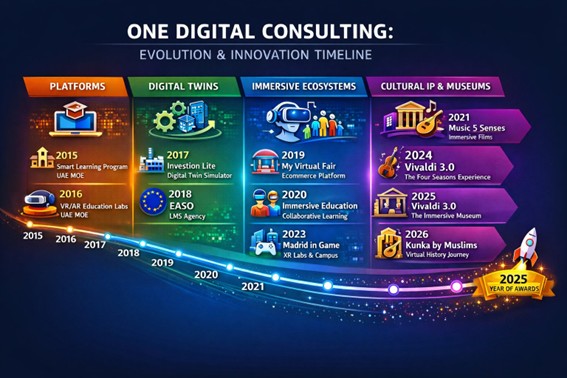
In 2003, I embarked on a transformative journey that led my past company, eLearning Consulting, to evolve an eLearning platform into a cutting-edge virtual educational platform known as “Edutopia.” This ambitious endeavor marked my foray into the realm of 3D worlds and virtual reality, bridging the gap between schools, educational communities, and innovative technology. Edutopia introduced avatars, interactive games, and an array of tools tailored for teachers, students, collaboration, monitoring, and evaluation—accessible from any PC.

My dedication bore fruit as thousands of students in Spain gained free access to this groundbreaking platform, supported by funding from the Ministerio de Educación, España.

Over two decades, my commitment to innovation in education extended to active involvement in classroom innovation programs and collaborations with prominent publishers. This commitment also manifested through investments in Research and Development programs under the aegis of the European Commission, resulting in the realization of several globally renowned projects.

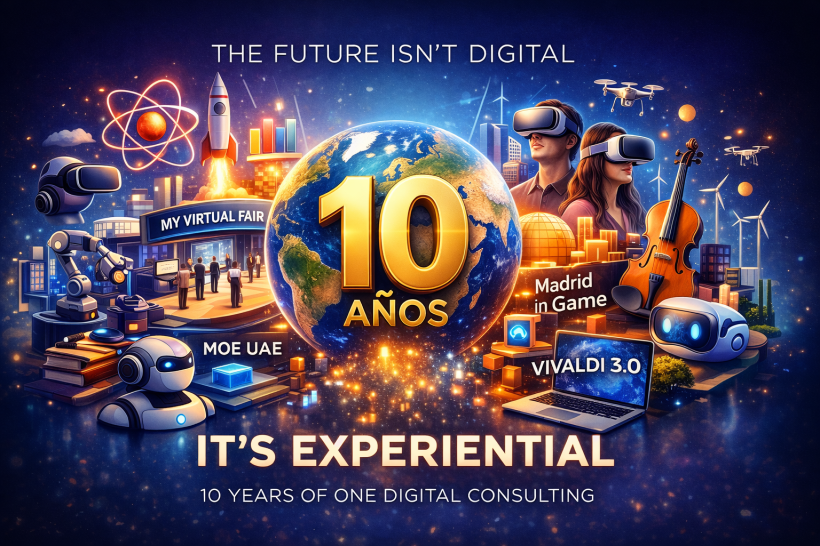
In 2013, my endeavors expanded beyond education as we developed pioneering simulators and digital twins for the industrial sector. Subsequently, in 2017, I launched the #SmartEducationLabs initiative for the Ministry of Education in the United Arab Emirates (UAE). This groundbreaking project championed advanced education and the digital transformation of classrooms.

This legacy persisted through 2022-23, marked by my instrumental role in establishing Advanced Labs and a Virtual Campus for Madrid’s gaming industry. This Virtual Campus is uniquely focused on nurturing entrepreneurial skills within the realm of video games and immersive experiences, ultimately fostering innovation within the gaming sector.

If you want to know more, please visit #MetaMinutes with my friend Rene Schulte here: https://lnkd.in/d5WXRf3P

If you want to know more about #SmartEducationLabs, visit
https://lnkd.in/dZciTDGa

Carlos J. Ochoa Fernández ©

La Frágil Levedad del SER

Muerto el #Metaverso, larga vida a la #AI o #ChapGPT,  debiera decir?

En este mundo tan frágil, efímero e inconsistente en el que vivimos últimamente, resulta muy preocupante la fragilidad de los argumentos que soportan grandes decisiones de la vida diaria.

El duro mundo del influencer, del bloguero, del metaversado, en busca de la última novedad, o al menos así lo piensan ellos, los lleva a ensalzar ídolos y convertirlos en villanos en apenas unos meses. El poder del marketing, y su influencia en tomas de decisiones rápidas, en aquellos que actúan sin pensar (proactivos dicen ellos, desinformados, pienso yo) es realmente brutal. El numero de impactos en este breve espacio de tiempo, supera con creces las expectativas que se podría alcanzar por cualquier otro medio. Una caza sin piedad de desinformados, ignorantes habidos de ser, sin ser.

Nuevas generaciones que buscan respuestas rápidas a problemas complejos, sin importarles la consistencia ni la transcendencia de las decisiones o el alcance de estas.

¿Resultado? lo tenemos a la vista. El presente se nos cruza y abofetea cada día con temas tan trascendentes y relevantes como la canción de Shakira y las historias de Pique. Algo que no se produce como fruto de la casualidad, o ¿ piensas que si?.

Hoy a nadie le extraña que escritores, blogueros o revistas técnicas internacionales, lleven haciendo trampas con sus artículos firmados, y elaborados por una máquina. Por no hablar de grandes ídolos musicales de un solo tema, elaborados íntegramente por ordenador.

El nuevo “Tsunami” golpea nuestras desoladas costas de la educación. Aparecen nuevas voces en el horizonte, cantos de sirena, intentando convencernos de los milagros de la Inteligenia Artificial” y los chats inteligentes, bla, bla, bla.

En 1988, durante mi etapa de formación en la Escuela de Informática de Siemens en Alemania, llegó a mis manos un libro verdaderamente apasionante: Sistemas Expertos, editado por Siemens y Dieter Nebendahl. Se convirtió en mi libro de cabecera durante algún tiempo y apoyó los desarrollos que llevamos a cabo en los días de los Sistemas de Información Geográfica.

A lo largo de los últimos 5 años, como Co-Chair del Comité de Educación de la Asociación (VRARA), hemos venido realizando una incesante labor de sensibilización, liderazgo y colaboración, con instituciones de primer nivel, en el estudio de implementación de metodologías, tecnologías inmersivas en la educación, tratando de avanzar en el desarrollo de un nuevo ecosistema educativo.

Humildemente creo que, en muchas ocasiones nos hemos anticipado a los tiempos, elaborando trabajos y estudios: El estudio de la VR/AR en Educación, Immersive Learning, Adcanced Simulations, Virtual Worlds and Metaeducation, Augmented Education for Augmented Soceity

A lo largo de la interesante sesión de la semana pasada “Are we ready for #AI in #Education”, se pusieron de manifiesto por un importante panel de expertos internacionales, algunos puntos esenciales, como que uno de los propósitos centrales de la educación es desarrollar pensadores críticos. También que la educación se ve comprometida cuando tratamos de impartirla a grupos grandes. Y cuando la discusión se lleva a grupos pequeños es donde se logra el verdadero aprendizaje. Otro de los problemas que se pusieron encima de la mesa, es que estemos demasiado centrados en hacer trampa en algunos aspectos del desarrollo de nuestras habilidades, lo cual nos puede llevar a un triste escenario de futuros lideres, en donde la sociedad en su conjunto puede verse afectada. ¿Como vamos a permitirnos esta falta de integridad académica y su transcendencia en el desarrollo de los futuros lideres de esta sociedad?.

Es necesario poner el foco en incorporar el pensamiento crítico y el pensamiento basado en la aplicación en el sistema educativo con mayor peso, en lugar de escribir la información aprendida a través de libros (digital/papel) a los que se les puede dar un peso más bajo. En la actualidad podemos decir sin lugar a duda, que la perspectiva desde el punto de vista de los estudiantes, justo la opuesta.

Esto es, “Augmented Education” es un salto cualitativo, en donde metodologías y tecnologías inmersivas en entornos disruptivos, nos hacen visualizar y definir un espacio de educación y formación más práctica, colaborativa, avanzado, adaptado a las necesidades de la sociedad actual y futura. Centrándose en algo más práctico, innovador, basado en experiencias, trabajo colaborativo, etc… algo que está en el polo opuesto a la formación tradicional basada en la lectura, el aprendizaje escrito, etc…

Hace ya seis años, con motivo del congreso internacional #Expolearning, tuve la oportunidad de presentar: La rebelión de las máquinas y la formación disruptiva. Una visión futuristica de la Educación Inmersiva y Experiencial y su posible evolución…y parece que fué ayer.

Y en menos de tres semanas, es cuando aparece la novedad “para algunos” de herramientas como #ChatGPT. Y creen descubrir el nuevo santo grial, saltando inmediatamente a un nuevo futuro… olvidando todos los paradigmas, visiones y avances realizados en estos últimos años.

En realidad, estamos ante un escenario muy similar al inicio de la Robotica. Cuando empezaron a invadir nuestras vidas hace más de 50 años, con orígenes similares y en muchos casos paralelos a la IA… lástima que la memoria sea frágil, la ignorancia tan atrevida y el marketing de las grandes multinacionales tan potente. Alimentando la maquinaria paralela de los blogueros, que necesitan cada día para sus blogs novedades, noticias únicas, aunque no lo sean, y no se procuren de estudiar las cosas, su evolución, orígenes, etc…baste con copiar y traducir un artículo de una prestigiosa revista americana, y publicarlo como propio, o filtarlo por ChatGPT?.

Gracias a dios, no es el caso de los eruditos mortales, sino de los metaignorantes, que cada vez ocupan más la superficie de este maltratado planeta.

Es curioso ver cómo, año tras año, encaminados hacia la transformación digital en la educación, simuladores inmersivos, trabajo en equipo, herramientas avanzadas, mayor interactividad, realidad aumentada en tiempo real… alejándonos de libros, textos, mensajes literales, y apoyándose en el mundo gráfico e interactivo, y ahora…. we go back again?.

No tengo la bola de cristal, pero los tiempos están cambiando en una dirección, en la que necesitamos mas “Human Touch”, “Etica”, “Honestidad”, “Sentido de Sacrificio, del esfuerzo”, “Sentido Solidario” y “Educación en Valores”.

Estas de acuerdo?…y Tu, que piensas?.

Carlos J. Ochoa Fernández ©

The Future of Immersive Technologies is to focus on the Value Chain

In times of uncertainty, investments must be accompanied by calm reflection when selecting our travel partners and not just service or product providers.

Today I want to invite you on a journey from the origins of interactive graphics systems to the world of the metaverse with my friend Marlon Molina.

I want to share with all of you the recent interview that the prestigious Computerworld University conducted with me through an old fellow traveler from the early days of Geographic Information Systems, Marlon Molina.

This a unique and passionate opportunity, in which we remember our steps and experiences in the graphic industry, for more than 30 years, Marlon at Intergraph and I at Siemens.

A time in which we feel like authentic active pioneers, and with the luck of being able to share these experiences with the new generations of enthusiasts of the interactive graphic world.

After a brief and charming conversation about the origins of digital image processing, the leadership of Silicon Graphics workstations (all major film productions used this technology, animation and simulation studios, etc…) and its disappearance by complete at present. Coming to the conclusion that the evolution of technology in recent years, leaves us with lights and shadows uncovered, which are repeated today and against which we must remain on guard.

In times of uncertainty, investments must be accompanied by calm reflection when selecting our travel partners and not just service or product providers.

After this brief review of the history of the interactive graphic world, we take a tour of the current state of immersive technologies, #virtual reality, #augmented reality, #Immersive experiences, the #Metaverse, and the new Vision from ONE Digital Consulting.

And one of the first reflections that come to mind is the insistence of the big manufacturers in selling us a wonderful, virtual and better world, without asking me if I am interested, if I like it, or if I simply prefer to solve the problems of this world. from my freedom, intelligence, and personal decision.

Join me in this conversation, only for fans of advanced technologies and their application to real industry. I hope you enjoy it as much as we did during the interview. I am looking forward to hearing your comments.

https://www.computerworlduniversity.es/tendencias/concentrarse-en-la-cadena-de-valor-es-la-clave-para-el-exito-de-la-realidad-virtual-y-aumentada

Have a great and wonderful day.

Carlos J. Ochoa Fernández ©

Building the Big Forest

I would love to share a very inspirational and personal conversation with Yoshi Garnica, from Impact Revolution.

Disreality is a fantasy journey into the human psyche that takes you on a ride through the twists and turns of that blurred line between what is real and what isn’t. Along the past recent years, let´s defined it as a hybrid experience, I have been walking around the universe of senses, emotions, arts, and social interaction in virtual worlds, as a real opportunity to build a free, democratic, and more sustainable world.

Nowadays, I am truly convinced that we need to act NOW. Tomorrow is too late.

All these reflections come to my mind during the several interviews, sessions, and talks with very good friends of the XR Community. I must say, thanks to all of you, for allowing me to walk along with you and learn together on these “long and winding road of immersive technologies”.

You can watch the complete interview here:

Key insights from the interview:

✳ He is living now in a privileged place: Guadarrama Natural Park – https://bit.ly/3dDukjB

✳ Happiest moment in Life: When he becomes a dad – holding his kids.

✳Last Impact Message to the world: “Build a big forest” – Metaphor to build a “big community” as a base for sustainability growth.

✳ The Education system is hard to Change.

✳Blade Runner 2049 (https://bit.ly/3A1Z5WQ is an example that VR did not change that much since 2017.

✳Experience with building Smart Education Labs with VR

✳Important to increase Accessibility of Technology to poorer countries – Reminded me to our last interview with Alfredo Serrano 🙏

✳Favorite professional project: “Music with 5 senses” – Virtual Concerts to CONNECT:

Arts 🔗 Creativity 🔗 Values 🔗 Nature🔗 Citizens

✳VR could help the Coaching Industry facilitate Engagement, Empathy, and Connection. Important the Environment, Story, and Technology used (for interaction). OpenBCI uses Neuroscience with VR.

✳Last Impactful message to Startups and Entrepreneurs ❤: Unique vision, Build Trust, Work a lot, Value Time, Strong Team, Good mentors, Create a Business Plan (importance of performing a Market Analysis, know your competitors!)

Was a great interview Carlos – Many thanks for sharing your valuable time with us. It’s much appreciated.

Best of luck in Revolutionizing the Education System!

All your thoughts and comments are very welcome.

Have a great time.

Carlos J. Ochoa Fernandez

Remembering my time as a student at Babson College.

One of my very best personal experiences throughout my long professional career was being a student in the International Entrepreneurship program at Babson College.

One of my very best personal experiences throughout my long professional career was being a student in the International Entrepreneurship program at Babson College.

In 1998, my past company Siemens decided to anticipate the competition, developing a joint program with Babson College to develop the Entrepreneurial spirit within the organization. Raising the talent of high potential and creating high-performance teams, capable of accelerating the transformation of a product company, into high-value-added services.

I was one of those selected for that program and thanks to that experience, allowed me to develop skills and abilities that helped me design and implement new global business areas at an international level, with a focus always on innovation.

A one-year international program, with professors from the most prestigious business schools, the participation of all managers of business centers and CEOs from different regions, in a spectacular and highly collaborative environment.

I seem to remember that this was one of the first international experiences of this type carried out by Babson College, between 1998 and 1999.

An unforgettable experience and I must thank Siemens and Babson College for that opportunity, whose principles continue to be a world reference today.

Carlos J. Ochoa ©

Las Claves para implantar las Tecnologías Inmersivas en la Educación.

Education is a system; teaching is an action; learning is a process. Terry Heick

Regulación y ética para máquinas, un desafío para los humanos
Analizamos el paradigma tecnológico al que se enfrenta el ser humano desde el punto de vista de los profesionales.

Educar, Educar y Educar…

¿Cómo vamos a formar en realidad virtual? La clave está en “educar, educar y educar”. De esta premisa parte Carlos J. Ochoa Fernández , fundador y CEO de ONE Digital Consulting y Co-Chair VRARA Metaverse on Dec 17 Education Committee, quien visitó nuestro auditorio en una de las sesiones del XR Fest.

Educar de forma transversal en nuevas tecnologías y crear documentos dirigidos a los centros educativos que aporten valor y formen al profesorado, es una tarea ardua pero necesaria. El primer paso es analizar el perfil de los profesores. En ocasiones, –comenta Ochoa– “queremos formar a gente o profesionales que son reacios o que no tienen la formación adecuada para luego impartir a los alumnos”.

Desde su organización, proponen un escrito de buenas prácticas donde reflexionan sobre la ayuda que necesitan los colegios, los docentes y los decisores para comprender la tecnología y ver el sentido de su aplicación en los métodos de enseñanza.

Marjorie NETANGE, directora de Desarrollo y Comunicación de la Escuela Superior de Música Reina Sofía, coincide en que “el docente tiene que trabajar su metodología en términos de cómo integrar la tecnología puntualmente”, pero sostiene que parte de su programa debe seguir una línea tradicional.

Según Angeles Heras Caballero, secretaria de Estado de Universidades de Ciencia, Investigación, Desarrollo e Innovación, es necesario orientar a los alumnos de universidades y posgrados hacia un futuro tecnológico. En España, ya se ha puesto en marcha la construcción de un Comité Científico de Ética, pero es imprescindible que estas normas coexistan con el resto de los actores empresariales, asociaciones e incluso, con otros Estados.

Una sesión, presentada y dirigida por Elena González de la Fuente, responsable del Espacio Fundación Telefónica.

Y con la participación de Ian Forrester, responsable del departamento de I+D de la BBC, el R&D Future Experiences, Pedro Lozano Alcolea, fundador y COO de Imascono, Marjorie NETANGE, directora de Desarrollo y Comunicación de la Escuela Superior de Música Reina SofíaCarlos J. Ochoa Fernández, fundador y CEO de ONE Digital Consulting y presidente de la Asociación VRARA Madrid y co-presidente global del Comité de VR Education de VRARA Metaverse on Dec 17, y Gonzalo Ruipérez García, CTO en EstudioFuture.

XRFEST , Fundación Telefónica Junio 2019.

Humanos Virtuales en el #Metaverso. ¿Y ahora que?

Fija tu rumbo a una estrella y podrás navegar a través de cualquier tormenta. Leonardo Da Vinci.

Humanos Virtuales en el #Metaverse. Congreso Digital Enterprise Show en #Madrid. Parece que, en los últimos meses, y en particular, desde que Mark Zuckerberg lanzó su proclama sobre Meta, ya todo se ha vuelto Meta-Verso. Y algo más que una metáfora, es una nueva dimensión a un mundo paralelo y finito, y que aún hoy, tiene muchos laberintos por desentramar…¿Estamos listos para ello?

El pasado mes de mayo tuve el inmenso placer de presentar estas reflexiones previas en torno a los Meta-humanos, en el Panel de VRARA del Congreso DES celebrado en Madrid y aquí os dejo el video de la presentación.

https://youtu.be/1QGRvcQiWqE

Desde ONE Digital Consulting, llevamos años desarrollando e implantando plataformas virtuales inmersivas para la educación: Talleres, Masterclasses, Formación de Profesores, Proyectos Colaborativos…en donde miles de estudiantes y profesores han participado de esta experiencia, viviéndola de una manera muy innovadora, inspiradora y positiva.

Estas experiencias nos han permitido desarrollar actividades On-Line, en modo síncrono y asíncrono en varios centros y países del mundo. Desde Estados Unidos, a la India, Rusia, Latino América, Europa, España…y contando con los mejores y mas experimentados colaboradores a nivel internacional. Algo inimaginable hace algunos años, hoy marca un punto de inflexión hacia el nuevo paradigma de una Educación Digital, más inclusiva, participativa, colaborativa, inspiradora, igualitaria, limpia y sostenible.

Cualquier comentario, es siempre bienvenido

Carlos J. Ochoa Fernández ©

Chronicles from the #RealVerse. Chapter II

Don’t run so fast Metaverse. The great trap of the Meta Boomers.

Learn from yesterday, live for today, hope for tomorrow. The important thing is not to stop questioning. Albert Einstein.

We live in an increasingly ephemeral and unequal society. Where the truth hides behind thick layers of images, headlines, screens … and where the speed of things is unreal. I do not know if this unjustified rush is accelerated by the need to flee or escape from ourselves.

So little do we like each other? Do we want to be immortal? Do we want to be other? We do not accept reality? … what is the real question to this paradigm. Maybe the is another answer to that question.

In the real world, nothing moves so fast, nor does society demand such ephemeral generosity, rather democracy, justice, equality, transparency … Searching for the ubiquity of the human being, ethics, transparency, honesty, goodness … .life, still exist … and are all around us, despite the Meta Boomers.

After more than 30 years involved in engineering, advanced technologies and working on real world projects … believe me if I tell you, I have never lived a similar time before. Where everyone is a futurist, visionary, town crier, spokesperson … without adding the slightest ounce of value to society, or to its real problems. Showing once again, that ignorance is very daring.

One of the great barriers to acceptance of advanced technologies is that they are credible, convey truthfulness, solve real problems, and the majority of society accepts and employs them for their mutual benefit.

Yesterday, without going any further, I saw a TV program about advanced robotics, the complexity of programming. The design of processes to teach robots to learn, to program tasks that are very easy for a human, but highly complex for a robot, until the final test is performed. This is a space for little fantasy and a lot of hard work. Today, robotics, 3D, AI, is taught in schools since childhood, it is understood, its contribution, benefits, risks … it is accepted and it lives with us a little more every day.

But this has required a long period of training, development, successful implementation in production processes, at home, in industry, etc … and this is not easy, nor is it free.

However, the futuristic Meta Boomers, the newcomers to this futuristic world, discovered by them of the “Edge-Science”, find a context, where everything seems simple and they give free rein to the verb, without the slightest training and with a wide and generous ignorance of the fundamentals, technologies, risks and benefits that these paradises of the future hide … Oops, how scary …

It seems that, if today you do not talk about the Metaverse, you are not “cool” beings, or you simply are not and you are not even … experts in Creative, Educational, Communicative, Digital, and blablative Metaverse, who go even under the stones, even to dare to prophesy that “The Future is in the Metaverse” … Oops how scary

The news of the day, which sweeps the networks, is that Bermuda is in the Metaverse, everyone retweets, and hallucinates, without knowing the vast majority, not even where Bermuda is … in short, “breaking news”.

Barriers to entry? Here is one that spreads like weeds in a natural forest: the Meta Boomers, who are going to leave the field depleted before we wake up from our first dream.

20 years ago, I was extremely lucky to participate in the development of a virtual educational platform. It included customizable avatars, virtual tutors, virtual tours of natural landscapes, interactive games, spaces for teachers, students and parents. In short, an entire educational community based on client-server architecture with hundreds of value-added services: Edutopia. Thousands of children from hundreds of schools in Spain were online users of this platform, now obsolete and lost in the cloud. I have to honestly say that this was available to the entire educational community for free and was beyond many Goals to be drawn in the short-lived near future.

We will see how this continues in the next chapter of Chronicles from RealVerse, enjoying a cup of Colombian coffee listening to John Coltrane, by the way, something real and extraordinary.

Carlos J. Ochoa Fernández ©

Re-innovate or die. And now What else?

Innovate, change or alter something, introducing new features. This is how the dictionary of the real academy defines this word so repeated and with such insistence in these times. There is no doubt that innovation can be redefined in many ways and in fact, it is done and interpreted that way, but if we want to simplify the definitions and make them understand in a simple way, we could say that it is the process of redoing, reinventing something in a different, efficient way that adds value. Think different, act different, reinvent yourself, anticipate, imagine, dream and carry it out with all the passion you are capable of showing.

These have been the keys to the success of some visionaries of the 20th. century, but also that of man throughout the development of its history, however only a select few are on the list of geniuses. Innovation is permanently linked to the evolution of man and it is enough to look around us in an instant of our life, on a street or in an office and look at the elements that surround us and that just a few years ago did not exist and even were unimaginable to think of its single existence in the near future like today.

And it is the “imagination” that allows us to dream of a new world and innovation that materializes it and turns it into reality. These being the key pieces for the beginning of a new cycle, where integrity, intuition, responsibility and creative thinking will be a benchmark for the new visionary companies of the 21st century.

In this minimal corner of the cyber-space, we are going to unravel the keys to Innovation, the barriers we encounter on a daily basis, the potential solutions and the escape routes, in order to come up with a mini guide for entrepreneurs who have decided to reinvent themselves or reinvent their business, promoting innovation at critical points in the value chain of their businesses.

However, over the last few years, it has become clear that beyond innovation there is entrepreneurship. And it is vitally important to understand that “Innovation” has no value until you are able to create a business model around this idea and turn it into a product or service ready to be sold. If you are not able to turn an “Idea” into something that creates customers, this does not work.

And that is when the figure of the entrepreneur makes sense. And that is why it is important to clearly identify and differentiate between innovators and entrepreneurs.

An “Innovator” is fundamentally a creator, a person capable of solving or solving problems in a creative and differential way, with great passion for constant improvement. Innovators are fundamentally thinkers. But an “Entrepreneur” is oriented to action, to the construction or materialization of things. This includes the development of a business around an innovative idea, for its subsequent materialization.

Therefore, when an “innovator” approaches us, with that special sparkle in his eyes and says: !!! I have a great idea!!!.

The entrepreneur’s response is immediate: Can we materialize and monetize it? Who is your target customer? What is the business model? Why will customers go crazy with your product?

Investing in Innovation without a developed entrepreneurship model is like throwing flowers into the sea, they will never grow.

Carlos J. Ochoa Fernández ©