Chronicles from the #RealVerse. Chapter II

Don’t run so fast Metaverse. The great trap of the Meta Boomers.

Learn from yesterday, live for today, hope for tomorrow. The important thing is not to stop questioning. Albert Einstein.

We live in an increasingly ephemeral and unequal society. Where the truth hides behind thick layers of images, headlines, screens … and where the speed of things is unreal. I do not know if this unjustified rush is accelerated by the need to flee or escape from ourselves.

So little do we like each other? Do we want to be immortal? Do we want to be other? We do not accept reality? … what is the real question to this paradigm. Maybe the is another answer to that question.

In the real world, nothing moves so fast, nor does society demand such ephemeral generosity, rather democracy, justice, equality, transparency … Searching for the ubiquity of the human being, ethics, transparency, honesty, goodness … .life, still exist … and are all around us, despite the Meta Boomers.

After more than 30 years involved in engineering, advanced technologies and working on real world projects … believe me if I tell you, I have never lived a similar time before. Where everyone is a futurist, visionary, town crier, spokesperson … without adding the slightest ounce of value to society, or to its real problems. Showing once again, that ignorance is very daring.

One of the great barriers to acceptance of advanced technologies is that they are credible, convey truthfulness, solve real problems, and the majority of society accepts and employs them for their mutual benefit.

Yesterday, without going any further, I saw a TV program about advanced robotics, the complexity of programming. The design of processes to teach robots to learn, to program tasks that are very easy for a human, but highly complex for a robot, until the final test is performed. This is a space for little fantasy and a lot of hard work. Today, robotics, 3D, AI, is taught in schools since childhood, it is understood, its contribution, benefits, risks … it is accepted and it lives with us a little more every day.

But this has required a long period of training, development, successful implementation in production processes, at home, in industry, etc … and this is not easy, nor is it free.

However, the futuristic Meta Boomers, the newcomers to this futuristic world, discovered by them of the “Edge-Science”, find a context, where everything seems simple and they give free rein to the verb, without the slightest training and with a wide and generous ignorance of the fundamentals, technologies, risks and benefits that these paradises of the future hide … Oops, how scary …

It seems that, if today you do not talk about the Metaverse, you are not “cool” beings, or you simply are not and you are not even … experts in Creative, Educational, Communicative, Digital, and blablative Metaverse, who go even under the stones, even to dare to prophesy that “The Future is in the Metaverse” … Oops how scary

The news of the day, which sweeps the networks, is that Bermuda is in the Metaverse, everyone retweets, and hallucinates, without knowing the vast majority, not even where Bermuda is … in short, “breaking news”.

Barriers to entry? Here is one that spreads like weeds in a natural forest: the Meta Boomers, who are going to leave the field depleted before we wake up from our first dream.

20 years ago, I was extremely lucky to participate in the development of a virtual educational platform. It included customizable avatars, virtual tutors, virtual tours of natural landscapes, interactive games, spaces for teachers, students and parents. In short, an entire educational community based on client-server architecture with hundreds of value-added services: Edutopia. Thousands of children from hundreds of schools in Spain were online users of this platform, now obsolete and lost in the cloud. I have to honestly say that this was available to the entire educational community for free and was beyond many Goals to be drawn in the short-lived near future.

We will see how this continues in the next chapter of Chronicles from RealVerse, enjoying a cup of Colombian coffee listening to John Coltrane, by the way, something real and extraordinary.

Carlos J. Ochoa Fernández ©

Re-innovate or die. And now What else?

Innovate, change or alter something, introducing new features. This is how the dictionary of the real academy defines this word so repeated and with such insistence in these times. There is no doubt that innovation can be redefined in many ways and in fact, it is done and interpreted that way, but if we want to simplify the definitions and make them understand in a simple way, we could say that it is the process of redoing, reinventing something in a different, efficient way that adds value. Think different, act different, reinvent yourself, anticipate, imagine, dream and carry it out with all the passion you are capable of showing.

These have been the keys to the success of some visionaries of the 20th. century, but also that of man throughout the development of its history, however only a select few are on the list of geniuses. Innovation is permanently linked to the evolution of man and it is enough to look around us in an instant of our life, on a street or in an office and look at the elements that surround us and that just a few years ago did not exist and even were unimaginable to think of its single existence in the near future like today.

And it is the “imagination” that allows us to dream of a new world and innovation that materializes it and turns it into reality. These being the key pieces for the beginning of a new cycle, where integrity, intuition, responsibility and creative thinking will be a benchmark for the new visionary companies of the 21st century.

In this minimal corner of the cyber-space, we are going to unravel the keys to Innovation, the barriers we encounter on a daily basis, the potential solutions and the escape routes, in order to come up with a mini guide for entrepreneurs who have decided to reinvent themselves or reinvent their business, promoting innovation at critical points in the value chain of their businesses.

However, over the last few years, it has become clear that beyond innovation there is entrepreneurship. And it is vitally important to understand that “Innovation” has no value until you are able to create a business model around this idea and turn it into a product or service ready to be sold. If you are not able to turn an “Idea” into something that creates customers, this does not work.

And that is when the figure of the entrepreneur makes sense. And that is why it is important to clearly identify and differentiate between innovators and entrepreneurs.

An “Innovator” is fundamentally a creator, a person capable of solving or solving problems in a creative and differential way, with great passion for constant improvement. Innovators are fundamentally thinkers. But an “Entrepreneur” is oriented to action, to the construction or materialization of things. This includes the development of a business around an innovative idea, for its subsequent materialization.

Therefore, when an “innovator” approaches us, with that special sparkle in his eyes and says: !!! I have a great idea!!!.

The entrepreneur’s response is immediate: Can we materialize and monetize it? Who is your target customer? What is the business model? Why will customers go crazy with your product?

Investing in Innovation without a developed entrepreneurship model is like throwing flowers into the sea, they will never grow.

Carlos J. Ochoa Fernández ©

Lead or follow the leader?. This is the question.

From the most remote origins of humanity, the need to know and discover things has been a struggle for subsistence and the development of life itself on the planet. With its evolution, scientific discoveries and technological evolution and innovation, it became a fundamental lever of human activity. But it has been from the last centuries and especially in this last decade, when this role has grown exponentially, almost in parallel with the same growth of the world population. The world’s population reached 7.7 billion in mid-2019, having added one billion people since 2007 and two billion since 1994 and with strong and accentuated tensions between rich and poor countries. In which the main viability engine up to now was development and growth, and which from now on must reconsider at a global level a new sustainability model that allows a fair redistribution of raw materials and finite wealth, to do so viable in the medium term.

Faced with this situation, the need for adaptation has always been an exceptional quality of the human being and therefore, the need to seek ways of evolution and sustainable growth necessarily goes through the impulse of research, development and innovation in search of a coherent and sustainable progress in convergent areas of knowledge and at a different time in different spaces. That is, in a global environment, although “knowledge” is accessible to everyone in almost real time, its application in different parts of the planet is affected by the variable time and this must be adapted to the reality of each space in each moment. With this, the potential benefits obtained in a certain place are not always replicable in the same way in other spaces / different territories.

To go beyond space and time in search of common patterns and homogeneous development denominators, or what is the same, geopolitical borders and time, MegaTrends are defined. Definition that comes from the world of research and that aims to redefine a framework of global trends in the evolution of society applied to all its agents (state, society and market). Or put another way, it is the knowledge and prediction of our possible future, where convergent sciences and technologies must deepen the path of sustainability.

After reviewing and reading in depth different works and documents of experts and reference organizations, everything seems to indicate that over the next few years, we are going to find an exaggerated and uncontrolled population growth, especially in countries of the so-called third world, a growth of the countries of the western world close to 2%, while in so-called emerging countries this will be higher than 7%. An aging population in developed countries with a clear inversion of the population pyramid, with all that this entails, is very considerable. If we add to this, that to guarantee this model of average growth of 5%, we have scarce natural resources to supply the planet and finite energy resources to guarantee growth and development, it is necessary to review the model urgently or this process is simply not feasible.

In any case, Megatrends have a different meaning for different agents, states, companies or individuals. The prediction or definition of potential future scenarios does not guarantee in any way that this is the true future to occur, since the development of society and its interrelationships is happening temporarily and the parameters are permanently affected by different situations that affect the total of the formula. That is, the evolution and development over time and the impact on society and its agents, is affecting day by day in the new future or immediate future that is presented to us and therefore the scenario that we draw from our knowledge in Today may not be anything like the one we will achieve tomorrow. But thanks to these models, we will have been able to adapt and theoretically, thanks to the knowledge and application of science and technological innovation, improve it.

In our particular case, we are going to consider “Megatrends” as a methodology for the future strategic and innovative development of society and, in particular, of companies. This methodology, combined with others, can help us to elaborate the development and innovation framework of our company. But this is not a guarantee of success or failure, since the way of applying these methodologies, for some visionaries, is based on the definition of scenarios in which multiple variables interact and therefore, they must be constantly reviewed and updated, to control and evaluate the interferences between all of them and see how it affects the evolution of our prediction model.

The methodology proposed here is a compendium resulting from the study of the analysis of the most prestigious consulting firms, organizations, universities and international magazines in the new technologies and innovation sector.

Imagining a global world in 2030, how we will live and develop our vital activity, we have grouped into five large blocks the Megatrends that will guide the world throughout this period and in particular, what will be their impact on society, on business and how they will affect current companies and how they must position themselves today to achieve success in the immediate future. Development opportunities in the markets, their size and main stakeholders.

Once these Megatrends have been defined, we identify possible ways of development and innovation, as well as possible actions to take into account in different scenarios. Each of these Mega Trends is broken down into trends, moving from an initial global perspective to a more local perspective and its potential geopolitical and temporal impact.

And finally, once all these possible trends have been analyzed, we identify potential actions to consider in each case, by the different agents involved in the process. Development of potential business opportunities, key and strategic businesses, as well as ways and keys for Innovation in them, identifying the value generated in a special way in the value chain of each business.

References: Fundación de la Universidad Autónoma de Madrid, Universidad Politécnica de Madrid, Fundación Telefónica, Fundación Acciona, European Commission, Onu, FAO, Unesco, Frost and Sullivan, e_Consultancy, TrendWatching, IDC, Gartner Group, Siemens, e_Consulting, Copenhagen Institute for Future Studies, Bertelsmann Future Challenges, MIT, IESE, Babson College Community, Harvard Business Review, LinkedIn Groups …

Carlos J. Ochoa Fernández ©

Chronicles from the #RealVerse. The New Age of Technology.

The world as we have created, it is a process of our thinking. It cannot be changed without changing our thinking. Albert Einstein.

In just 12 months, the world has been turned upside down. And all predictive models, analyzes and future scenarios have become obsolete without being able to identify a single true and predictable answer about the immediate future.

Phrases such as transformation, adaptation to change, permanently reinventing oneself, sustainable and safe models, have become a thing of the past. All these definitions require a new mentality, attitude and mental strength far superior to what we were used to living together to face the day to day and think about a future, to some extent, stable.

And for this, we must be able to quickly change our way of thinking, acting and conceiving the world as we have done until now, or we will not be able to survive these new, unpredictable and uncertain scenarios.

Living in a permanent state of alert requires great mental strength, but above all honesty, ethics, networking and handling of truthful information in real time. In order to be able to anticipate unwanted scenarios, with some success.

And unfortunately, all this is what we are missing right now, as a society and as individuals.

It is enough to go outside and take a walk through our cities, fields, hospitals, schools, offices and homes and see how in just a few months, everything has radically changed.

While it is true that technology has invaded every corner and space of our lives. Changing our habits and ways of doing things, of working, of communicating … this change must accelerate and find a new temporary space, where we can significantly improve our quality of life. From communications, to transport, through health and health, science, energy, food, in short, each and every one of the activities that human beings develop in their day-to-day life must be reimagined in some way. way, allowing us to benefit from the efficient use of technologies.

Despite what we think, the planet earth has been inhabited in its greatest historical period by dinosaurs. And in the timeline, the human being has barely lived a hundredth part of it. The stone age lasted 200,000 years, the agricultural age 10,000 years, the industrial age 200 years and barely 60 years the era of high technology.

And it has been in this short period of time that the greatest technological developments have taken place, accompanied by the greatest industrial development on the planet, accompanied by the greatest environmental impact in known history.

The main technological drivers are all exponential, the development of broadband, the greater storage and data processing capacity, the increase in clean power generation plants, development in the world of medicine and telemedicine, have democratized access and benefit of technologies by facilitating and simplifying access and management of them to citizens.

The interrelationships that occur between major trends “Megatrends”and “Innovation” is a fertile field for scientists and developers in which new business models and opportunities must be modeled for the new society of the Post-Covid Era.

But in this new scenario, society has new expectations and demands that it is willing to lead, to guarantee a model of sustainability and well-being sponsored by this technological revolution. Transparency, honesty, veracity, ethics, environmental impact, sociability, sustainability, are some of the values ​​that emerge from the new society.

The British Alan Turin, considered by some the father of artificial intelligence, laid the foundations of what we know today as the “Information Society”, back in the 1930s and 1940s. One of the founders of modern computing, he was capable of programming everything that could be specified by an algorithm. And on the other hand, the American Claude Elwood Shannon, elaborated the bases and the essence of the communication mechanism, defining the concept of “information”, as the foundation and ability to store and transfer data. Almost seventy years later, those basic foundations and incipient beginnings of information and communication technologies have become fundamental elements of our current society and future evolution and development.

We are facing a unique opportunity, albeit in a very complex scenario. Which leads us to take on new challenges with courage, seek creative and innovative solutions, focusing primarily on those aspects that provide the greatest value and in which the capacity for green and sustainable leadership makes a difference to us to continue betting on life in the blue Planet.

Carlos J. Ochoa Fernández ©

The History Behind the Picture

At the end of the 60s, a small group of young people from Madrid, decided to start entrepreneurial careers in the energy sector. And they planned to go to Germany, the benchmark of heavy industry at that time. A trip to the unknown world for them. An unknown country, an unknown language, an unknown culture,… quite a challenge for that group of people, moved by their concerns, intuition and entrepreneurial inspiration.

Four friends, from very humble families, and with no other financial capacity than the result of their work and personal savings effort, in a small car with their suitcases full of dreams. On the way back, they set up one of the first black heat radiator companies in Spain. Later they created a new industrial facility…and so on. Finally, with a lot of work, effort, and sacrifice, they turned their dreams into reality.

One of those entrepreneurs was my father, from whom I inherited the effort, work, and dedication to developing ideas.

Sometimes, overwhelmed by the artificial speed to which we are subjected, we forget who we are, where we come from, and where we are going. Thanks to your effort and energy, today I can be proud to share this little story in your tribute, recognition, and gratitude to “a good man”, my father.

Years later, I started my professional career at Siemens, remembering the first tracks from my father…

In a world where practically everything is trivialized, where irrelevance is rewarded, fake news is the order of the day, our identity is usurped by digital vultures disguised as virtual fairies, many young people pretend to become millionaires by influencing to millions of followers with the most outlandish stupidities, it takes a bit of good sense, to value the things that really have it and to jump a step or two to get out of this crushing mediocrity, to which some ignorantly enlightened visionaries try to lead us.

The picture illustrates the short story related to effort, work, sacrifice and vision of the future, since it is the only toy that I keep on my shelf, and it was his gift from that trip to Germany.

The machine needs to be powered every single day as if it were the last day you are going to go out on the winding and complex paths of life.

Have a nice and safe day.

Carlos J. Ochoa Fernández ©
VR Day in Madrid 2019

Carlos J. Ochoa, Co_Chair VRARA Education Committee. Madrid 23.11.2019

This weekend the Madrid VRAR Association participated in the VRDayMadrid 2019, within the “Virtual Reality World Day” framework. An event organized by xRWorldMadrid, an independent VR/AR group, sponsored by Everys, GreySkull and butic The New School and supported by VR/AR Association, Samsung, Talent Garden and RealoVirtual.

As one of the world’s referenced VR/AR live events, the VRDay draws industry experts from many verticals and enthusiasts from companies and universities to explore the latest advancements, knowledge and prototypes in VR/AR technology. During the complete Saturday, more than 200 attendants, 20+ speakers, 10+ exhibitors, 5 thematic round tables, 2 workshops and 2 masterclasses and an amazing demo zone with more than 10 VRAR experiences and a live performance, 2019 was the biggest year yet (according the organization).

The VRARA was represented by the Chapter President and Co_Chair of Education, Carlos J. Ochoa and 4 of our most relevant Spanish members and executives from: Seabery, Virtualware, participating in the Industry panel, Visyon presenting the Masterclass ElCano360 and ONE digital consulting in the Education and Training panel.

We were invited to participate in the Roundtable of VR in Education, to talk about future scenarios of “Training of Educators of the Future”. An excellent panel of experts with the participation of Chelu Martin from the IE Business School, Gonzalo Mariscal from XRLab of the European University, Carlos J. Ochoa of VR/AR Association and ONE Digital Consulting and the and moderated by Marco Antonio Fernández of Butic the New School .It was a very special opportunity to contrast the state of VR / AR in Education, from different points of view: University labs, teachers and industry. This allowed us contrasting realities materialized in ongoing projects, and new challenges that are drawn on a very attractive and exciting horizon.

We had the opportunity to present the Association Ecosystem and in particular, the activities of the Education Committee, the White Paper of VR in Education and the VR/AR in Education Survey.

I want to express my gratitude to the organization and their team, for the excellent work done hanging the “Sold Out” sign for several weeks before.

“Attending VRDayMadrid was a great opportunity to showcase the strength of the VR/AR ecosystem, and the incredible talent at work, case studies and projection from our members and share experiences and opportunities with other local companies and institutions.” Carlos J. Ochoa, President of the VRAR Association Madrid Chapter.

Media news: Real o Virtual

Carlos J. Ochoa Fernández ©

Future Jobs Opportunities around VR/AR

Versatilist with Carlos Ochoa Fernandez Podcast.

New technologies are an emerging industry creating employment opportunities and entrepreneurial possibilities. Virtual reality and augmented reality represent incredible areas of opportunity. VR failed to live up to the wildest promises when the new VR systems launched in 2015. But the number of job postings for VR and AR have risen 93% since 2015, with 17% of that growth happening in the past year.

According to projections set out by the European Commission, market demands for qualified information and communications technology (ICT) specialists will not be met, seeing a shortfall of up to 500,000 ICT professionals in 2020. Virtual and Augmented Reality solutions are amongst those with some of the highest market demand in the ICT sector.

Education is the driver to sustainability of our economy and functionality of humanity. Every day we seek to learn new information and and the way we take the lessons and apply to our every day lives, is the core of how we explore we grow and we build futures for ourselves.

Through virtual and augmented realities, the technology allows the user to immerse themselves into a virtual experience or location and the immersive lesson is retained at a much quicker time frame with a more impactful lasting memory. VR & Learning, by the National Training Laboratory, advised retention rates for lecture style learning were at 5%, with reading rates at 10%. Meanwhile, the teaching method of VR scored a retention rate of 75%.

Understanding we are moving into a world with exponential growth, there is a necessary requirement to update our education system to support innovative technologies to understand how it will be applied to job creation and support digital support systems and processes.


It is in this context where Patrick O’Shea and myself, both from ILRN (Immersive Learning Research Network) and ICICLE ( X-Reality for Learning and Performance Augmentation, IEEE IC Industry Consortium on Learning Engineering) talk about Immersive Education around Cup of Coffee.

Thanks Patrick, for this amazing conversation.

Join the podcast here

Carlos J. Ochoa Fernádez ©

Impact and ROI of VR/AR in Training

The opportunities that will be available to enterprises when the Fourth Industrial Revolution begins to take shape, like increased productivity and efficiency, improved customer quality service, faster access to data and value information, and massive improvements in enterprise. These are the 4 key success factors for the next years.

“We must develop a comprehensive and globally shared view of how technology is affecting our lives and reshaping our economic, social, cultural, and human environments. There has never been a time of greater promise, or greater peril.” — Klaus Schwab

We are just starting 2019, with new hopes, ideas and projectsaround Innovation in Education and Training.

The opportunities that will be available to enterprises when the Fourth Industrial Revolution begins to take shape, like increased productivity and efficiency, improved customer quality service, faster access to data and value information, and massive improvements in enterprise. These are the 4 key success factors for the next years.

Investment increasing competitiveness: A clear majority of companies believe that the digital transformation to Industry 4.0 will increase their competitiveness. Utilise opportunities and reduce risks: Industry 4.0 represents a number of major opportunities for all companies. It will open up new ways for companies to integrate their customers’ needs and preferences into their development and production processes.

Standardisation through Integration IT Tech and Digital Data: There is some confusion with companies trying to innovate as to which standards will be adopted in the next five years. A huge challenge to overcome will be to derive a standardized system that works for all parties and allows for both horizontal and vertical integration, and results in maximum value for both present and future investments.

Workforce and new skills development: Adjusting talent and IT resources. Most of the companies noted that in many areas, they do not have all the staff they need to make the digital transformation to Industry 4.0. The need for efficient and effective workforce training and operation in the industry worldwide has become acute. Thanks to VR/AR, “advanced reality technologies and” digital information, technicians can focus in operation & maintenance task enables them to cut down on time spent on administrative tasks, significantly increasing productivity.

Disruptive Innovation through empowering exponential technologies: A majority of companies agreed that there are several key technologies “AI, IoT, BC, 3D printing, XR or Digital Twins” will accelerate the transformation process. Most companies are only just beginning to use these technologies and there is a risk that they may miss the opportunity, because some competitors have already been implementing it for several years and are developing the next generation of applications.

Simulation-based training, prefaced with traditional training methods on process fundamentals, is the most efficient and fastest way to train new employees and prepare them for their daily work providing huge added value and benefits.

Imagine how data transmitted from a Wind Turbine engine while operates can provide advance notice of potential failures. How use digital twins for engines to monitor their performance and carry out preventive maintenance. How digital twin technology is helping Companies understand and manage the operation of machines operating around the world, and craft next generation wind turbines and engines.

What is the digital twin?: A digital twin, according to Gartner, is a digital representation of a physical object. It includes the model of the physical object, data from the object, a unique one-to-one correspondence to the object, and the ability to monitor the object.

Digital twins have been around since 2002, but only gained momentum in 2017 when they became cost-effective thanks to an increase in the adoption of the Internet of Things (IoT) and cloud technologies, which enable low cost, high storage and compute, high throughput messaging, security, and more.

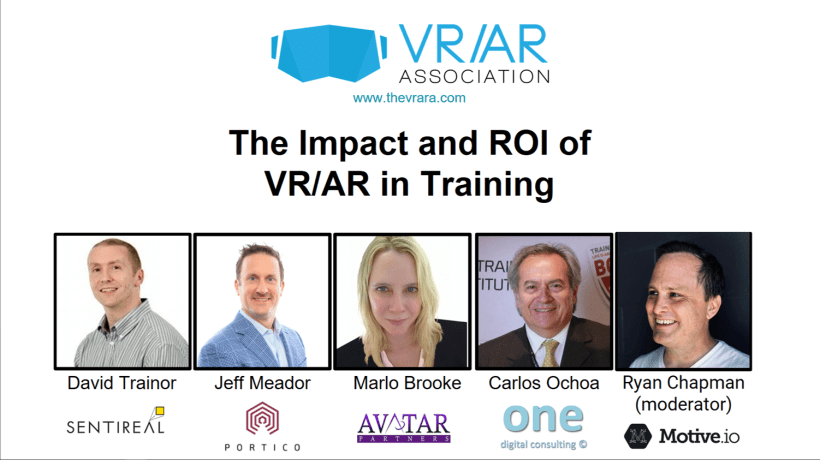
Now, you can join Carlos J. Ochoa Fernández and ONE Digital Consulting at VR/AR webinar to discuss the ‘Impact and ROI of VR/AR in Training‘ released last January 16, 2019. With David Trainor, Jeff Meador, Marlo Brooke. With 300+  registered attendees for this live session including Q&A.

The VR/AR Association (VRARA) is an international organization designed to foster collaboration between innovative companies and people in the VR and AR ecosystem that accelerates growth, fosters research and education, helps develop industry standards, connects member organizations and promotes the services of member companies

Carlos J. Ochoa Fernández

VR/AR Education Committe Highlights 2018

With 2018 almost coming to a close, we’d love to highlight some facts and figures from the year and share all the different activities released from Education Committee.

This is the story of one year team work, reflections, sharing, experiences, meetings, failures, celebrating little wins and, for sure, growth.

We have just complete our first guides, case studies, life webinars and best practices white paper.

Sometimes I feel we made a heroic effort and starting reaching out to more and more people from all over the VR/AR Educational Community. We probably sent hundreds of emails, made the social media accounts, and talked with hundreds of people in last 12 months.

Last but not least, millions of people will use VR/AR technology in Education in the next coming years. I believe we are in a good starting point, demonstrating that VR/AR Edu Committee can be a powerful platform for teachers, students and professionals to speak out and bring light to the Future of Education.

We hope this roundup inspires you to engage into the VR/AR Edu Community.

With a little “big” help from my friends !!! Julie, Kris, Molly, Pradeep, Mfon, Kevin, Josue, Mike…and many more !!!

You can dowload the complete document here:

Carlos J. Ochoa Fernández ©

VR/AR Platform for Industry Base Training Simulation. Digital Transformation 4.0

Introduction

“The world as we have created it is a process of our thinking. It cannot be changed without changing our thinking.” Albert Einstein

New technologies such as robotics and artificial intelligence are rapidly changing people’s jobs and lives. Technology will likely change many of the existing jobs, requiring workers and companies to adjust. While maybe only one in seven jobs may be lost to automation, many others will change significantly. OECD suggests in their study (2018), that around 14% of all jobs across 32 countries analyzed have a high risk of automation, 32% of existing jobs may experiment significant changes to how they are carried out.

In the other hand, and according the OECD study, It is now essential to ensure that schools prepare students for a world in which they will constantly be adjusting to new technologies, new business models, and new ways of working. People, including young people, need to be equipped with the type of skills that will allow on average 25 job changes throughout their lives.

Therefore, learning systems will need to adapt to the changes brought about by automation and teach students that allow them to take full advantage of the current wave of technology adoption. This includes skills such as cognitive and social intelligence but also extends to the skills needed to work effectively in a digital context, both as specialists and users of digital technologies.

The Problem

New technologies are an emerging industry creating employment opportunities and entrepreneurial possibilities. According to projections set out by the European Commission, market demands for qualified information and communications technology (ICT) specialists will not be met, seeing a shortfall of up to 500,000 ICT professionals in 2020. Virtual and augmented reality solutions are amongst those with some of the highest market demand in the ICT sector.

Skills, and skills development, are an essential component of all efforts in this challenging society. Too many workers are simply unprepared to meet the needs of firms, particularly in more competitive economic environments.

DY5Ph1DWAAAg879.jpg large

New skills development for more complex jobs. Technicians need to be proficient and continue to change rapidly as tasks become more complex. Find the right info at the right moment. Technicians need fast access to all info to take fast and complex decisions.

  • High Training cost. Time, resources, maintaining and quality standards.
  • High Digitalization cost (paper, no automatization processes, decision taking.
  • Data integration and maintenance. Manuals, documents, files…
  • Data visualization. Format, devices, availability, usability
  • Risk and performance. New complex and unpredictable situations. Actions based training methodology.
  • Quality, standards and sustainability
  • Expensive or difficult hand on practice (no experimental, no real world scenarios…)
  • Difficult assessment process.
  • Most of existing solutions are isolated, expensive and not VRAR designed. Also have a gap about learning processes, methodology and instructional approach.

Industry 4.0 Demands

Industry 4.0 is the of automation information and data exchange in manufacturing technologies.

  • Enhanced productivity through optimization and automation
  • Provide real-time data and information for real-time decision makers
  • Business continuity through advanced maintenance and monitoring possibilities
  • Higher quality products as a result of real-time monitoring and technology convergence
  • Better working conditions and superior sustainability

The Solution

Engineers with the right skills, with excellent experience and experimental training, are the demands in the industry worldwide has become acute.

The need for efficient and effective workforce training and operation in the industry worldwide has become acute. VR/AR technology is the most efficient and fastest way to educate new employees and prepare them for their daily work. In the other hand, thanks to VR/AR and digital information, technicians can focus in operation & maintenance task enables them to cut down on time spent on administrative tasks, significantly increasing productivity.

VR/AR and Simulation-based training also helps increase professionals confidence because they can practice procedures until they master them. Further, trainees become more aware of safety procedures because they have to follow them in the simulations.

  • Reducing Training cost. Experiential training based on VRAR give real-time feedback and improve the efficiency of skills transfer, increased knowledge retention.
  • Reducing delays & mistakes. Using collaborative VR/AR and digital documentation, we can integrate “all in one”. Minimizing time to action in decision taking providing technicians the complete background on an asset, detailing all historical data and repairs to quickly perform the task in hand.
  • Improving Safety. Dangerous or difficult to replicate scenarios can be safely simulated with VRAR. This allows monitors to repeatedly practice critical or unpredictable scenarios while preventing damage to equipment and persons.
  • Improving quality, and standards. Experiential Training through VRAR actively participation in the activities obtaining higher retention rates. VRAR training allows employees to receive hands on training, in a virtual environment. This prevents expensive down time and disruptions in normal operations
  • Improving assessment process. Monitors can create specific complex situations to be resolved, where Technicians will deal with different task according their role or responsibility. They will be evaluated based on their performance on the relevant work items. This information can be integrated with the company’s internal record keeping systems for certification and/or administrative action.
  • Improving preventive maintenance. Integrating applications such as electronic job sheets and work orders, on-site workers are now able to focus on the task in hand while using VRAR with tablets or smartphones. This enables them to cut down on time spent at the end of each day on administrative tasks, significantly increasing productive-time.
  • Faster and better decisions. Decision-making processes are shortened and problems, as well as defects, can be resolved quickly and efficiently

Imagine a solution, that deploy an intelligent VR/AR ecosystem with the specialized know-how to turn unstructured data into value-adding information, e.g. when providing services such as preventive maintenance, security management or operational management.

Investion Grafico

INNVESTION is an innovative platform for training, operation and maintenance of plant services, which includes advanced reality technologies in immersive environments (extened reality, 360º video), methodologies in a modular architecture (on/off line).

A cloud platform will allow users to download the different modules. For a full INNVESTION experience, the user only needs a mobile device and VR glasses that fit the device. The training centre will need an internet connection to download modules, and these can be accessed offline, only needing a connection to update new content.

INNVESTION can be used from a single “low cost” VR device based on Samsung Gear Mobile VR, through the most advanced VR Oculus Rift, HTC Vive configuration.

The Results

Simulation-based training, prefaced with traditional training methods on process fundamentals, is the most efficient and fastest way to train new employees and prepare them for their daily work providing huge added value and benefits:

  • Faster project execution, commissioning and ”time to market“ through improved collaboration
  • Cost savings through consistent plant information available at all times
  • Higher plant availability, integrating real time data and 3d visualization
  • Safe and efficient plant operations

Carlos J. Ochoa Fernández ©

More information:

www.carlosjochoa.com

www.onedigitalconsulting.com