Education in the Age of Intelligence: Present and Future Skills Society Actually Needs

A narrative review and policy-oriented framework for vocational resilience, immersive education, and labor-market alignment (2024–2025 evidence)

Abstract

Public discourse on artificial intelligence (AI) and work often centers on job displacement and the future value of technical skills. However, recent European and global evidence indicates that many labor-market pressures stem less from automation than from persistent shortages in essential, vocation-driven professions (e.g., healthcare, education, engineering) and from skills mismatches.

This article synthesizes 2024–2025 evidence from the European Commission, Eurostat, the European Parliament, the OECD, Eurofound, the World Health Organization, and the World Economic Forum to (1) quantify demand signals in critical sectors, (2) distinguish “future skills” from “enduring societal skills,” and (3) propose immersive, experience-based education as a scalable mechanism to surface latent vocations and improve education-to-work transitions.

We argue that the most strategic response to AI-era disruption is not solely reskilling for technology, but redesigning education to cultivate vocational identity, ethical judgment, and systems thinking—capabilities that strengthen societal resilience across demographic change, healthcare strain, and infrastructure transitions.

Keywords: Artificial intelligence, workforce shortages, vocational education, immersive learning, XR, teacher shortages, healthcare workforce, skills mismatch, EU labor market, future of work.

1. Introduction

AI is accelerating task automation and reshaping occupational content. Yet the policy-relevant question is no longer only “which jobs will disappear,” but “which roles must reliably be staffed for society to function.” In the European Union (EU), labor and skills shortages are reported across all Member States, with employers indicating difficulty filling roles and the Commission identifying EU-wide shortage occupations.

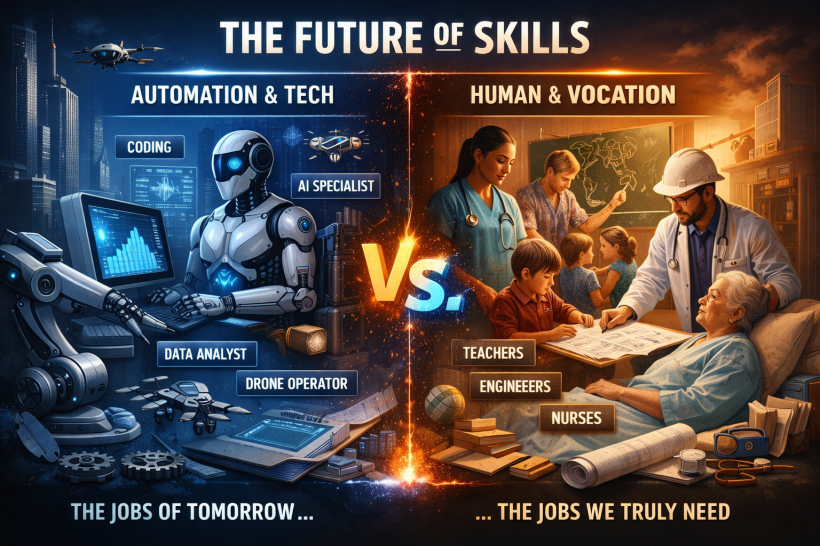
This reframes “future skills” as a dual challenge: (a) technology fluency and adaptation, and (b) the cultivation of vocation-driven professions (health, education, engineering) where the binding constraint is often labor supply, working conditions, and training pathways rather than automation.


2. Method

This paper uses a narrative review approach, prioritizing 2024–2025 institutional sources and official statistical reporting: European Commission policy releases; Eurostat labor indicators; European Parliament briefings; OECD Education at a Glance 2024; Eurofound EWCS 2024 first findings; WHO workforce projections; and WEF Future of Jobs 2025. The goal is integrative synthesis (not meta-analysis), linking labor-demand signals to education design principles.


3. Evidence: Demand Signals and Skills Mismatches in Europe and Globally

3.1 EU-wide labor and skills shortages (systemic, not marginal)

The European Commission reports shortages rising across all Member States, noting that 63% of SMEs in a cited survey cannot find the talent they need and that the Commission has identified 42 shortage occupations.
This indicates structural mismatches: vacancies persist even where overall employment is high.

3.2 Job vacancies as a measurable pressure indicator (Eurostat)

Eurostat’s job vacancy statistics provide the harmonized framework for tracking labor-market tightness and the distribution of vacancy pressures across sectors and time.
Eurostat’s euro indicators also report vacancy rates by economic activity (EU and euro area), supporting sector-level interpretation (e.g., where shortages concentrate).

3.3 Healthcare: the clearest case of “enduring societal demand”

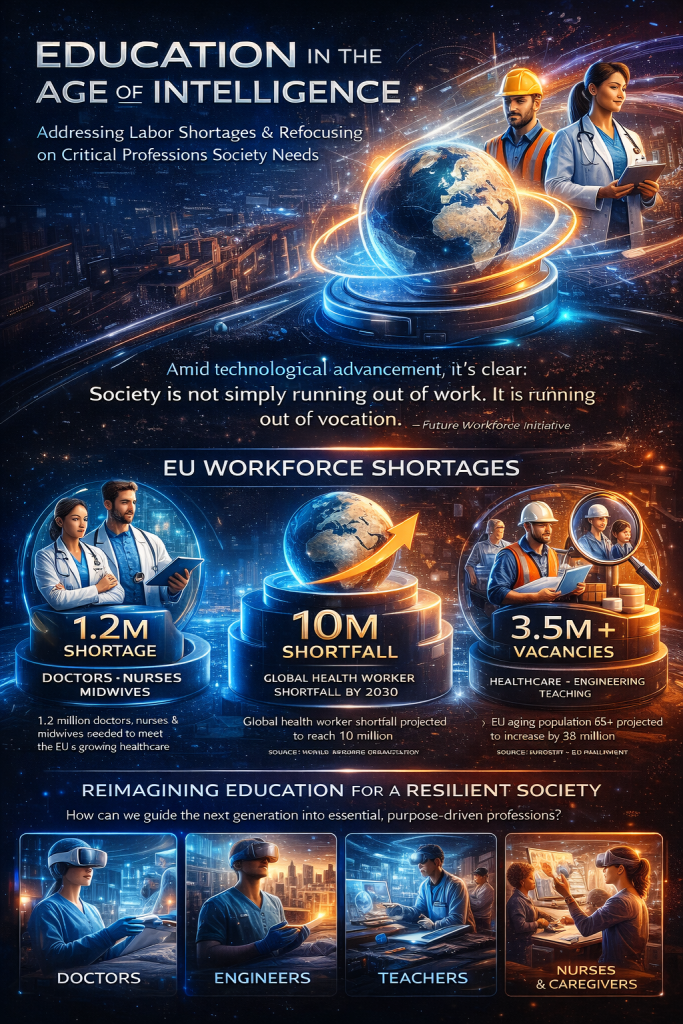
EU health workforce shortages have been estimated at ~1.2 million doctors, nurses and midwives (as of 2022) in a European Parliament briefing referencing Health at a Glance: Europe 2024.
Globally, WHO reporting to its governing bodies indicates a projected shortage of ~11.1 million health workers by 2030 (with regional variation).
Complementary 2025 analysis also frames the expected global shortage as at least 10 million by 2030, emphasizing macroeconomic and health-burden implications.
Taken together, these sources support a robust range: ~10–11 million global shortfall by 2030, with the EU facing acute shortages as well.

3.4 Education: teacher shortages and system capacity

OECD’s Education at a Glance 2024 documents teacher workforce conditions and explicitly addresses where countries stand regarding shortages.
This matters because education systems are the pipeline for healthcare, engineering, and scientific capacity; teacher shortages can become a compounding constraint on future workforce supply.

3.5 Working conditions and retention: the “hidden” skills crisis

Eurofound’s EWCS 2024 first findings provide EU-wide evidence on job quality and working conditions—factors that strongly influence recruitment and retention in shortage sectors (notably health and care).
In practice, shortages often reflect not only training capacity, but also job quality, emotional demands, and sustainability of working lives.


4. Reframing the Skills Debate: “Future Skills” vs. “Enduring Societal Skills”

4.1 What employers say is rising (WEF 2025)

WEF’s Future of Jobs Report 2025 identifies skills increasing in importance through 2030, including AI and big data, analytical thinking, creative thinking, resilience/flexibility/agility, and technological literacy.
Notably, the “future skills” list is not purely technical; it elevates cognitive and socio-emotional capabilities.

4.2 Enduring societal skills (a functional definition)

This paper proposes “enduring societal skills” as capabilities that sustain essential services under demographic pressure, infrastructure transition, and systemic shocks:

  • Clinical judgment, empathy, ethical decision-making (health and care)
  • Pedagogy, mentorship, relational intelligence (education)
  • Systems thinking, safety culture, design responsibility (engineering/infrastructure)
  • Scientific reasoning, experimentation, uncertainty handling (research and innovation)

These are vocation-linked and inherently shaped by practice, context, and responsibility.


5. Why Immersive Education is Strategically Relevant

If the binding constraint is vocational supply and sustained motivation, education must support vocational discovery earlier and more vividly than traditional abstract instruction.

Immersive (XR) education can:

  1. Reduce abstraction by allowing learners to “enter” professional contexts (e.g., clinical simulations, engineering systems, lab environments).
  2. Strengthen vocational identity through situated experience (students can test-fit roles before commitment).
  3. Improve skills transfer by training perception-action loops (procedural and spatial reasoning), complementing conceptual learning.
  4. Support equity of access by bringing high-cost environments (operating rooms, labs) into schools.

Crucially, immersive learning should not be positioned as replacing teachers, but as increasing the bandwidth of teaching—especially relevant when teacher shortages strain system capacity.


6. Policy and Institutional Implications

6.1 Align education pathways with shortage intelligence

EU-wide shortage monitoring exists; educational planning should map curricula, capacity, and guidance systems directly to shortage occupations and regional demand.

6.2 Fund vocation-first immersive programs early

Given health workforce projections and EU shortages, early-stage exposure to healthcare and care professions is a high-leverage intervention.

6.3 Retention as a skills strategy

Shortage policy must treat job quality as part of the skills system; improving conditions stabilizes supply (Eurofound evidence supports the salience of job quality and sector-specific burdens).


7. Limitations

This is a narrative synthesis; it does not estimate causal impacts of immersive education on vocational entry or retention. Additionally, vacancy rates measure demand pressure but do not fully represent unmet societal need (which can be constrained by budgets, staffing ratios, and service design).


8. Conclusion

The AI-era skills agenda should be rebalanced: beyond preparing learners for digital tools, education must cultivate the vocations society cannot afford to undersupply. The evidence from 2024–2025 EU and global sources is consistent: shortages in health, education capacity constraints, and widespread employer-reported skills gaps indicate that the central challenge is not simply automation, but vocational resilience. Immersive education—implemented intentionally and aligned with shortage intelligence—offers a practical pathway to reveal hidden vocations and reconnect learning with real societal value.

In a world shaped by artificial intelligence, the most powerful investment is not smarter machines. It is inspired humans.

The future will not be defined by what AI can do. It will be defined by what we choose to become.

And the professions that will endure — doctors, nurses, engineers, educators, scientists — are not relics of the past. They are the backbone of the future.

If we want a resilient society, we must design education not around automation — but around vocation.

Because progress is not measured by efficiency alone.

It is measured by the people we prepare to lead it.

Statistical Reference Appendix (Selected Sources)

World Health Organization (2023). Global Strategy on Human Resources for Health.

World Economic Forum (2023). Future of Jobs Report.

OECD (2023). Education at a Glance.

European Parliament Briefings (2024–2025). Health Workforce Analysis.

Eurostat (2024). EU Job Vacancy Statistics.

United Nations (2022). World Population Prospects.

Global Infrastructure Hub (2022). Global Infrastructure Outlook.

International Labour Organization (2018). Care Work and Care Jobs for the Future of Decent Work.

European Commission. (2024, March 20). Tackling labour and skills shortages in the EU (Press release).

European Commission, Directorate-General for Employment, Social Affairs and Inclusion. (2024). Commission sets out actions to tackle labour and skills shortages (Newsroom item; includes action plan and factsheet links).

European Parliament Research Service. (2025). Healthcare in the EU shortages (At a glance briefing).

Eurofound. (2025). European Working Conditions Survey 2024: First findings (EF24026).

Eurostat. (2024/2025). Job vacancy statistics (Statistics Explained).

Eurostat. (2025). Euro area job vacancy rate… (Euro indicators, Q2 2025).

McKinsey Health Institute. (2025, May 14). Heartbeat of health: Reimagining the healthcare workforce of the future.


Carlos J. Ochoa Fernández ©

Learning in the Age of Intelligence: XR + AI as Drivers of Educational Evolution

The convergence between XR and AI is transforming education like never before. My latest report presents a strategic, evidence-based roadmap for responsibly integrating immersive technologies between 2025 and 2030. With the market projected to grow from $11.5 billion to $72.9 billion by 2030, the combination of more accessible hardware, creative AI, and experiential learning is building a more immersive—and more human—future for education.

The Augmented Campus: Designing Immersive, Responsible, and Measurable Education

The convergence between XR and AI is transforming education like never before. My latest report presents a strategic, evidence-based roadmap for responsibly integrating immersive technologies between 2025 and 2030. With the market projected to grow from $11.5 billion to $72.9 billion by 2030, the combination of more accessible hardware, creative AI, and experiential learning is building a more immersive—and more human—future for education.

This vision was reaffirmed at the Best of XR + AI Education Summit 2025 by the VR/AR Association, where over 30 international experts shared a common belief: the future of education must be inclusive, ethical, and sustainable—driven by technology that amplifies human talent and creativity, not replaces them.

The convergence of XR (VR/AR/MR) with generative and analytical AI is creating the first operating system for experiential learning.

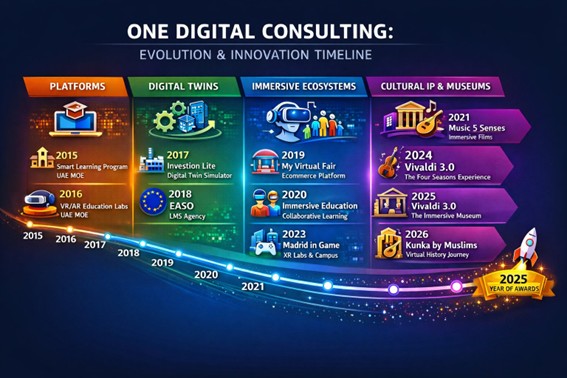
This article outlines an ideal ecosystem—XR Labs, 3D simulators, 360° tours, Google Earth VR, digital twins, AI scenes, and persistent virtual worlds—accompanied by an actionable roadmap (0–36 months), a maturity model, a reference architecture, verifiable KPIs, and an implementation playbook validated through real projects by ONE Digital Consulting and SmartEducationLabs.


Vision: From the Classroom to the Augmented Campus

Education from 2025 to 2030 will be built on measurable, accessible, and secure immersive experiences, combining repetitive (simulator-based), situational (360° tours, Google Earth VR), and systemic (digital twins) learning.
AI plays three fundamental roles:

  1. Co-creation of content (scripts, assets, assessments)
  2. Pedagogical orchestration (adaptation, feedback, traceability via xAPI)
  3. Operational assistance (teacher support, headset MDM, accessibility QA)

XR + AI in Education 2030: Strategic Vision and Framework

Developed by Carlos J. Ochoa (ONE Digital Consulting & SmartEducationLabs), the report presents a strategic and practical vision for how the convergence of Extended Reality (XR)—encompassing VR, AR, and MR—and Artificial Intelligence (AI) will reshape education over the next decade.,

Its proposal integrates infrastructure, pedagogy, ethics, and data analytics into a coherent ecosystem designed for measurable, sustainable, and equitable outcomes.


1. A New Architecture for Learning

The model envisions a shift from the traditional classroom to the Augmented Campus—an environment where immersive practice and adaptive intelligence redefine how we learn. XR enables emotional, first-hand engagement with knowledge, while AI acts as co-creator, orchestrator, and evaluator, personalizing learning according to each student’s pace, style, and emotional state.

Key components of the ideal ecosystem include:

Learning Experiences

  • XR Labs (multidisciplinary): VR/AR stations with MDM control, safety zones, display casting, and session recording.
  • 3D Simulators: From soft skills (AI-driven role-play) to technical training (STEM, healthcare, vocational). Compatible with OpenXR and glTF/USDZ formats.
  • 360° Tours: Proprietary and licensed libraries, rapid authoring templates, mobile and headset accessibility.
  • Google Earth VR & Geospatial Learning: Projects on social sciences, history, climate, and biodiversity, enriched with AI-based data layers and storytelling.
  • Digital Twins: Virtual replicas of labs, campuses, or factories for real-time, situational, and what-if learning scenarios.
  • AI Scenes: AI-generated or expandable scenes with characters, branching narratives, and formative assessments.
  • Persistent Virtual Worlds: Hubs for classes, hackathons, science fairs, and inter-institutional collaborations with federated identities and spatial voice communication.

2. Evidence and Impact

Research shows a 10–20% increase in academic performance, a 25–40% reduction in mastery time, and a 30% improvement in retention compared to traditional methods.
Immersive learning also enhances empathy, inclusion, and soft skills—promoting a more human-centered, accessible approach to education.

Flagship examples—such as XRLabs & SmartEducationProgram (UAE Ministry of Education), the XR Teachers Training Program (European Commission), Music and the Five Senses (Reina Sofia School of Music), Digital Twins for Vocational Training, The Immersive Universe of Vivaldi’s Four Seasons, and the Educational Metaverse for the Junta de Extremadura and AENOR—demonstrate XR’s proven effectiveness across STEM, industry, creative arts, and corporate training, achieving significant performance gains and cost reductions.


3. Roadmap to 2030

The report proposes a four-phase roadmap (0–36 months) to evolve from pilot projects to institutional transformation:

  1. Foundation (0–3 months): Create an XR committee, run initial pilots, and establish ethical guidelines.
  2. Integration (3–6 months): Connect XR systems to LMS, deploy XR Labs, and define first KPIs.
  3. Scaling (6–12 months): Embed XR into curricula, launch microcredentials, and deploy learning analytics.
  4. Consolidation (2–3 years): Implement campus-wide digital twins, build regional networks, and ensure financial sustainability.

This roadmap is supported by standardized metrics (learning, cost, wellbeing, accessibility) and an institutional maturity model (M0–M4) that tracks progress from isolated pilots to interconnected ecosystems.


4. Strategic Impact

The adoption of XR + AI drives a paradigm shift across multiple dimensions:

  • Pedagogical: From passive to experiential and emotional learning.
  • Economic: Reduced operational costs and expanded global access.
  • Social: Greater inclusion, universal accessibility, and sustainable development.
  • Ethical: Data protection, algorithmic transparency, and digital wellbeing.

Conclusion

The future of education depends not only on technology but on ethical and pedagogical integration.
When united under a solid governance model focused on human learning, XR and AI transform classrooms into living ecosystems of exploration, creativity, and collaboration.

ONE Digital Consulting invites institutions and governments to co-create this immersive, inclusive, and measurable educational future that will define the next decade.

📩 Contact the experts: madrid@onedigitalconsulting.eu

Carlos J. Ochoa Fernández ©

The Future of Immersive Technologies is to focus on the Value Chain

In times of uncertainty, investments must be accompanied by calm reflection when selecting our travel partners and not just service or product providers.

Today I want to invite you on a journey from the origins of interactive graphics systems to the world of the metaverse with my friend Marlon Molina.

I want to share with all of you the recent interview that the prestigious Computerworld University conducted with me through an old fellow traveler from the early days of Geographic Information Systems, Marlon Molina.

This a unique and passionate opportunity, in which we remember our steps and experiences in the graphic industry, for more than 30 years, Marlon at Intergraph and I at Siemens.

A time in which we feel like authentic active pioneers, and with the luck of being able to share these experiences with the new generations of enthusiasts of the interactive graphic world.

After a brief and charming conversation about the origins of digital image processing, the leadership of Silicon Graphics workstations (all major film productions used this technology, animation and simulation studios, etc…) and its disappearance by complete at present. Coming to the conclusion that the evolution of technology in recent years, leaves us with lights and shadows uncovered, which are repeated today and against which we must remain on guard.

In times of uncertainty, investments must be accompanied by calm reflection when selecting our travel partners and not just service or product providers.

After this brief review of the history of the interactive graphic world, we take a tour of the current state of immersive technologies, #virtual reality, #augmented reality, #Immersive experiences, the #Metaverse, and the new Vision from ONE Digital Consulting.

And one of the first reflections that come to mind is the insistence of the big manufacturers in selling us a wonderful, virtual and better world, without asking me if I am interested, if I like it, or if I simply prefer to solve the problems of this world. from my freedom, intelligence, and personal decision.

Join me in this conversation, only for fans of advanced technologies and their application to real industry. I hope you enjoy it as much as we did during the interview. I am looking forward to hearing your comments.

https://www.computerworlduniversity.es/tendencias/concentrarse-en-la-cadena-de-valor-es-la-clave-para-el-exito-de-la-realidad-virtual-y-aumentada

Have a great and wonderful day.

Carlos J. Ochoa Fernández ©

Remembering my time as a student at Babson College.

One of my very best personal experiences throughout my long professional career was being a student in the International Entrepreneurship program at Babson College.

One of my very best personal experiences throughout my long professional career was being a student in the International Entrepreneurship program at Babson College.

In 1998, my past company Siemens decided to anticipate the competition, developing a joint program with Babson College to develop the Entrepreneurial spirit within the organization. Raising the talent of high potential and creating high-performance teams, capable of accelerating the transformation of a product company, into high-value-added services.

I was one of those selected for that program and thanks to that experience, allowed me to develop skills and abilities that helped me design and implement new global business areas at an international level, with a focus always on innovation.

A one-year international program, with professors from the most prestigious business schools, the participation of all managers of business centers and CEOs from different regions, in a spectacular and highly collaborative environment.

I seem to remember that this was one of the first international experiences of this type carried out by Babson College, between 1998 and 1999.

An unforgettable experience and I must thank Siemens and Babson College for that opportunity, whose principles continue to be a world reference today.

Carlos J. Ochoa ©

Humanos Virtuales en el #Metaverso. ¿Y ahora que?

Fija tu rumbo a una estrella y podrás navegar a través de cualquier tormenta. Leonardo Da Vinci.

Humanos Virtuales en el #Metaverse. Congreso Digital Enterprise Show en #Madrid. Parece que, en los últimos meses, y en particular, desde que Mark Zuckerberg lanzó su proclama sobre Meta, ya todo se ha vuelto Meta-Verso. Y algo más que una metáfora, es una nueva dimensión a un mundo paralelo y finito, y que aún hoy, tiene muchos laberintos por desentramar…¿Estamos listos para ello?

El pasado mes de mayo tuve el inmenso placer de presentar estas reflexiones previas en torno a los Meta-humanos, en el Panel de VRARA del Congreso DES celebrado en Madrid y aquí os dejo el video de la presentación.

https://youtu.be/1QGRvcQiWqE

Desde ONE Digital Consulting, llevamos años desarrollando e implantando plataformas virtuales inmersivas para la educación: Talleres, Masterclasses, Formación de Profesores, Proyectos Colaborativos…en donde miles de estudiantes y profesores han participado de esta experiencia, viviéndola de una manera muy innovadora, inspiradora y positiva.

Estas experiencias nos han permitido desarrollar actividades On-Line, en modo síncrono y asíncrono en varios centros y países del mundo. Desde Estados Unidos, a la India, Rusia, Latino América, Europa, España…y contando con los mejores y mas experimentados colaboradores a nivel internacional. Algo inimaginable hace algunos años, hoy marca un punto de inflexión hacia el nuevo paradigma de una Educación Digital, más inclusiva, participativa, colaborativa, inspiradora, igualitaria, limpia y sostenible.

Cualquier comentario, es siempre bienvenido

Carlos J. Ochoa Fernández ©

Reimagining Business Performance with Industry XTR

Industry XTR, are we facing the new paradigm?

Never give up on your dreams. John Ford

It is true that Covid has been a serious blow in the advance towards Industry 4.0 in those companies in transition. Being seriously affected the processes of digital transformation, production, logistics, dependence on raw materials, etc., increased by the lockdown of a large number of organizations. Accepting that 4 key pillars of Industry 4.0 are digitization processes, including standardization, development of new skills and workforce, disruptive innovation processes and investments, it is clear that COVID has paralyzed industrial activity worldwide. And we continue to suffer from its impact today …

After participating in the first face-to-face events and conferences during the last weeks, we meet again and discuss the “state of the art” of our companies, markets and new challenges that we will face in this new scenario.

And it is true, that even today, many are not able to assimilate, that nothing is going to be as before. Although the changes do not occur at the speed that some want us to see, it is true that many activation and acceleration mechanisms have already been put in place in some organizations. Strengthening them in leadership positions and others are being left behind, hopelessly.

If we analyze some of the pillars of Industry 4.0, it is in investments, standardization, skills development and disruptive innovation where the greatest imbalances have occurred. Clearly marking a before and after among some companies, which have been able to adapt to the new situation quickly and activate very solid innovation mechanisms. While others continue to try to compose themselves and return to a pre-pandemic scenario, as a valid point of reference.

Reimagining Business Performance with Industry XTR, are we facing the new paradigm?

Perhaps it is time to take a step further, seeking “exponential acceleration” and trying to find solutions to new problems that we would never have thought before would intercept our society in this way. So, continuing with the transition to Industry 4.0 again, today, no longer makes sense.

From my perspective, today, it is absolutely necessary to rethink the industry model, without trying to return to pre-pandemic scenarios, which would be a long delay and would take us back to 2019.

Rethinking Industry 4.0, facing a new Business Performance process, accelerating the digitization processes, through the integration of disruptive technologies, with the training of new skills, incorporating new forms of more efficient and remote collaborative work, developing assessment platforms, empowerment and loyalty of high-performance teams and decentralizing networks of supply and manufacturing in several poles and suppliers, seeking value in competition in efficiency and innovation, and not only in price, not so dependent on a single country.

Anticipate foreseeable future crisis situations, minimizing the risks and impacts of technological threats, lack of talent to lead change, cybersecurity and virtual transactions, new pandemics, energy crises, climate change, shortage of raw materials and logistics. Just to list a small series of them.

Those who have the new vision of Industry XTR, will be able to lead the transformation of society to a safer and more sustainable planet.

These are some reflections, while I have my cup of coffee and listening my jazz session. Today with Kenny Burrel, enjoy.

Thoughts and ideas are always welcome. Good afternoon and good luck from the RealVerse.

Carlos J. Ochoa Fernández ©

Chronicles from the #RealVerse. Chapter II

Don’t run so fast Metaverse. The great trap of the Meta Boomers.

Learn from yesterday, live for today, hope for tomorrow. The important thing is not to stop questioning. Albert Einstein.

We live in an increasingly ephemeral and unequal society. Where the truth hides behind thick layers of images, headlines, screens … and where the speed of things is unreal. I do not know if this unjustified rush is accelerated by the need to flee or escape from ourselves.

So little do we like each other? Do we want to be immortal? Do we want to be other? We do not accept reality? … what is the real question to this paradigm. Maybe the is another answer to that question.

In the real world, nothing moves so fast, nor does society demand such ephemeral generosity, rather democracy, justice, equality, transparency … Searching for the ubiquity of the human being, ethics, transparency, honesty, goodness … .life, still exist … and are all around us, despite the Meta Boomers.

After more than 30 years involved in engineering, advanced technologies and working on real world projects … believe me if I tell you, I have never lived a similar time before. Where everyone is a futurist, visionary, town crier, spokesperson … without adding the slightest ounce of value to society, or to its real problems. Showing once again, that ignorance is very daring.

One of the great barriers to acceptance of advanced technologies is that they are credible, convey truthfulness, solve real problems, and the majority of society accepts and employs them for their mutual benefit.

Yesterday, without going any further, I saw a TV program about advanced robotics, the complexity of programming. The design of processes to teach robots to learn, to program tasks that are very easy for a human, but highly complex for a robot, until the final test is performed. This is a space for little fantasy and a lot of hard work. Today, robotics, 3D, AI, is taught in schools since childhood, it is understood, its contribution, benefits, risks … it is accepted and it lives with us a little more every day.

But this has required a long period of training, development, successful implementation in production processes, at home, in industry, etc … and this is not easy, nor is it free.

However, the futuristic Meta Boomers, the newcomers to this futuristic world, discovered by them of the “Edge-Science”, find a context, where everything seems simple and they give free rein to the verb, without the slightest training and with a wide and generous ignorance of the fundamentals, technologies, risks and benefits that these paradises of the future hide … Oops, how scary …

It seems that, if today you do not talk about the Metaverse, you are not “cool” beings, or you simply are not and you are not even … experts in Creative, Educational, Communicative, Digital, and blablative Metaverse, who go even under the stones, even to dare to prophesy that “The Future is in the Metaverse” … Oops how scary

The news of the day, which sweeps the networks, is that Bermuda is in the Metaverse, everyone retweets, and hallucinates, without knowing the vast majority, not even where Bermuda is … in short, “breaking news”.

Barriers to entry? Here is one that spreads like weeds in a natural forest: the Meta Boomers, who are going to leave the field depleted before we wake up from our first dream.

20 years ago, I was extremely lucky to participate in the development of a virtual educational platform. It included customizable avatars, virtual tutors, virtual tours of natural landscapes, interactive games, spaces for teachers, students and parents. In short, an entire educational community based on client-server architecture with hundreds of value-added services: Edutopia. Thousands of children from hundreds of schools in Spain were online users of this platform, now obsolete and lost in the cloud. I have to honestly say that this was available to the entire educational community for free and was beyond many Goals to be drawn in the short-lived near future.

We will see how this continues in the next chapter of Chronicles from RealVerse, enjoying a cup of Colombian coffee listening to John Coltrane, by the way, something real and extraordinary.

Carlos J. Ochoa Fernández ©

Re-innovate or die. And now What else?

Innovate, change or alter something, introducing new features. This is how the dictionary of the real academy defines this word so repeated and with such insistence in these times. There is no doubt that innovation can be redefined in many ways and in fact, it is done and interpreted that way, but if we want to simplify the definitions and make them understand in a simple way, we could say that it is the process of redoing, reinventing something in a different, efficient way that adds value. Think different, act different, reinvent yourself, anticipate, imagine, dream and carry it out with all the passion you are capable of showing.

These have been the keys to the success of some visionaries of the 20th. century, but also that of man throughout the development of its history, however only a select few are on the list of geniuses. Innovation is permanently linked to the evolution of man and it is enough to look around us in an instant of our life, on a street or in an office and look at the elements that surround us and that just a few years ago did not exist and even were unimaginable to think of its single existence in the near future like today.

And it is the “imagination” that allows us to dream of a new world and innovation that materializes it and turns it into reality. These being the key pieces for the beginning of a new cycle, where integrity, intuition, responsibility and creative thinking will be a benchmark for the new visionary companies of the 21st century.

In this minimal corner of the cyber-space, we are going to unravel the keys to Innovation, the barriers we encounter on a daily basis, the potential solutions and the escape routes, in order to come up with a mini guide for entrepreneurs who have decided to reinvent themselves or reinvent their business, promoting innovation at critical points in the value chain of their businesses.

However, over the last few years, it has become clear that beyond innovation there is entrepreneurship. And it is vitally important to understand that “Innovation” has no value until you are able to create a business model around this idea and turn it into a product or service ready to be sold. If you are not able to turn an “Idea” into something that creates customers, this does not work.

And that is when the figure of the entrepreneur makes sense. And that is why it is important to clearly identify and differentiate between innovators and entrepreneurs.

An “Innovator” is fundamentally a creator, a person capable of solving or solving problems in a creative and differential way, with great passion for constant improvement. Innovators are fundamentally thinkers. But an “Entrepreneur” is oriented to action, to the construction or materialization of things. This includes the development of a business around an innovative idea, for its subsequent materialization.

Therefore, when an “innovator” approaches us, with that special sparkle in his eyes and says: !!! I have a great idea!!!.

The entrepreneur’s response is immediate: Can we materialize and monetize it? Who is your target customer? What is the business model? Why will customers go crazy with your product?

Investing in Innovation without a developed entrepreneurship model is like throwing flowers into the sea, they will never grow.

Carlos J. Ochoa Fernández ©

Lead or follow the leader?. This is the question.

From the most remote origins of humanity, the need to know and discover things has been a struggle for subsistence and the development of life itself on the planet. With its evolution, scientific discoveries and technological evolution and innovation, it became a fundamental lever of human activity. But it has been from the last centuries and especially in this last decade, when this role has grown exponentially, almost in parallel with the same growth of the world population. The world’s population reached 7.7 billion in mid-2019, having added one billion people since 2007 and two billion since 1994 and with strong and accentuated tensions between rich and poor countries. In which the main viability engine up to now was development and growth, and which from now on must reconsider at a global level a new sustainability model that allows a fair redistribution of raw materials and finite wealth, to do so viable in the medium term.

Faced with this situation, the need for adaptation has always been an exceptional quality of the human being and therefore, the need to seek ways of evolution and sustainable growth necessarily goes through the impulse of research, development and innovation in search of a coherent and sustainable progress in convergent areas of knowledge and at a different time in different spaces. That is, in a global environment, although “knowledge” is accessible to everyone in almost real time, its application in different parts of the planet is affected by the variable time and this must be adapted to the reality of each space in each moment. With this, the potential benefits obtained in a certain place are not always replicable in the same way in other spaces / different territories.

To go beyond space and time in search of common patterns and homogeneous development denominators, or what is the same, geopolitical borders and time, MegaTrends are defined. Definition that comes from the world of research and that aims to redefine a framework of global trends in the evolution of society applied to all its agents (state, society and market). Or put another way, it is the knowledge and prediction of our possible future, where convergent sciences and technologies must deepen the path of sustainability.

After reviewing and reading in depth different works and documents of experts and reference organizations, everything seems to indicate that over the next few years, we are going to find an exaggerated and uncontrolled population growth, especially in countries of the so-called third world, a growth of the countries of the western world close to 2%, while in so-called emerging countries this will be higher than 7%. An aging population in developed countries with a clear inversion of the population pyramid, with all that this entails, is very considerable. If we add to this, that to guarantee this model of average growth of 5%, we have scarce natural resources to supply the planet and finite energy resources to guarantee growth and development, it is necessary to review the model urgently or this process is simply not feasible.

In any case, Megatrends have a different meaning for different agents, states, companies or individuals. The prediction or definition of potential future scenarios does not guarantee in any way that this is the true future to occur, since the development of society and its interrelationships is happening temporarily and the parameters are permanently affected by different situations that affect the total of the formula. That is, the evolution and development over time and the impact on society and its agents, is affecting day by day in the new future or immediate future that is presented to us and therefore the scenario that we draw from our knowledge in Today may not be anything like the one we will achieve tomorrow. But thanks to these models, we will have been able to adapt and theoretically, thanks to the knowledge and application of science and technological innovation, improve it.

In our particular case, we are going to consider “Megatrends” as a methodology for the future strategic and innovative development of society and, in particular, of companies. This methodology, combined with others, can help us to elaborate the development and innovation framework of our company. But this is not a guarantee of success or failure, since the way of applying these methodologies, for some visionaries, is based on the definition of scenarios in which multiple variables interact and therefore, they must be constantly reviewed and updated, to control and evaluate the interferences between all of them and see how it affects the evolution of our prediction model.

The methodology proposed here is a compendium resulting from the study of the analysis of the most prestigious consulting firms, organizations, universities and international magazines in the new technologies and innovation sector.

Imagining a global world in 2030, how we will live and develop our vital activity, we have grouped into five large blocks the Megatrends that will guide the world throughout this period and in particular, what will be their impact on society, on business and how they will affect current companies and how they must position themselves today to achieve success in the immediate future. Development opportunities in the markets, their size and main stakeholders.

Once these Megatrends have been defined, we identify possible ways of development and innovation, as well as possible actions to take into account in different scenarios. Each of these Mega Trends is broken down into trends, moving from an initial global perspective to a more local perspective and its potential geopolitical and temporal impact.

And finally, once all these possible trends have been analyzed, we identify potential actions to consider in each case, by the different agents involved in the process. Development of potential business opportunities, key and strategic businesses, as well as ways and keys for Innovation in them, identifying the value generated in a special way in the value chain of each business.

References: Fundación de la Universidad Autónoma de Madrid, Universidad Politécnica de Madrid, Fundación Telefónica, Fundación Acciona, European Commission, Onu, FAO, Unesco, Frost and Sullivan, e_Consultancy, TrendWatching, IDC, Gartner Group, Siemens, e_Consulting, Copenhagen Institute for Future Studies, Bertelsmann Future Challenges, MIT, IESE, Babson College Community, Harvard Business Review, LinkedIn Groups …

Carlos J. Ochoa Fernández ©

Chronicles from the #RealVerse. The New Age of Technology.

The world as we have created, it is a process of our thinking. It cannot be changed without changing our thinking. Albert Einstein.

In just 12 months, the world has been turned upside down. And all predictive models, analyzes and future scenarios have become obsolete without being able to identify a single true and predictable answer about the immediate future.

Phrases such as transformation, adaptation to change, permanently reinventing oneself, sustainable and safe models, have become a thing of the past. All these definitions require a new mentality, attitude and mental strength far superior to what we were used to living together to face the day to day and think about a future, to some extent, stable.

And for this, we must be able to quickly change our way of thinking, acting and conceiving the world as we have done until now, or we will not be able to survive these new, unpredictable and uncertain scenarios.

Living in a permanent state of alert requires great mental strength, but above all honesty, ethics, networking and handling of truthful information in real time. In order to be able to anticipate unwanted scenarios, with some success.

And unfortunately, all this is what we are missing right now, as a society and as individuals.

It is enough to go outside and take a walk through our cities, fields, hospitals, schools, offices and homes and see how in just a few months, everything has radically changed.

While it is true that technology has invaded every corner and space of our lives. Changing our habits and ways of doing things, of working, of communicating … this change must accelerate and find a new temporary space, where we can significantly improve our quality of life. From communications, to transport, through health and health, science, energy, food, in short, each and every one of the activities that human beings develop in their day-to-day life must be reimagined in some way. way, allowing us to benefit from the efficient use of technologies.

Despite what we think, the planet earth has been inhabited in its greatest historical period by dinosaurs. And in the timeline, the human being has barely lived a hundredth part of it. The stone age lasted 200,000 years, the agricultural age 10,000 years, the industrial age 200 years and barely 60 years the era of high technology.

And it has been in this short period of time that the greatest technological developments have taken place, accompanied by the greatest industrial development on the planet, accompanied by the greatest environmental impact in known history.

The main technological drivers are all exponential, the development of broadband, the greater storage and data processing capacity, the increase in clean power generation plants, development in the world of medicine and telemedicine, have democratized access and benefit of technologies by facilitating and simplifying access and management of them to citizens.

The interrelationships that occur between major trends “Megatrends”and “Innovation” is a fertile field for scientists and developers in which new business models and opportunities must be modeled for the new society of the Post-Covid Era.

But in this new scenario, society has new expectations and demands that it is willing to lead, to guarantee a model of sustainability and well-being sponsored by this technological revolution. Transparency, honesty, veracity, ethics, environmental impact, sociability, sustainability, are some of the values ​​that emerge from the new society.

The British Alan Turin, considered by some the father of artificial intelligence, laid the foundations of what we know today as the “Information Society”, back in the 1930s and 1940s. One of the founders of modern computing, he was capable of programming everything that could be specified by an algorithm. And on the other hand, the American Claude Elwood Shannon, elaborated the bases and the essence of the communication mechanism, defining the concept of “information”, as the foundation and ability to store and transfer data. Almost seventy years later, those basic foundations and incipient beginnings of information and communication technologies have become fundamental elements of our current society and future evolution and development.

We are facing a unique opportunity, albeit in a very complex scenario. Which leads us to take on new challenges with courage, seek creative and innovative solutions, focusing primarily on those aspects that provide the greatest value and in which the capacity for green and sustainable leadership makes a difference to us to continue betting on life in the blue Planet.

Carlos J. Ochoa Fernández ©