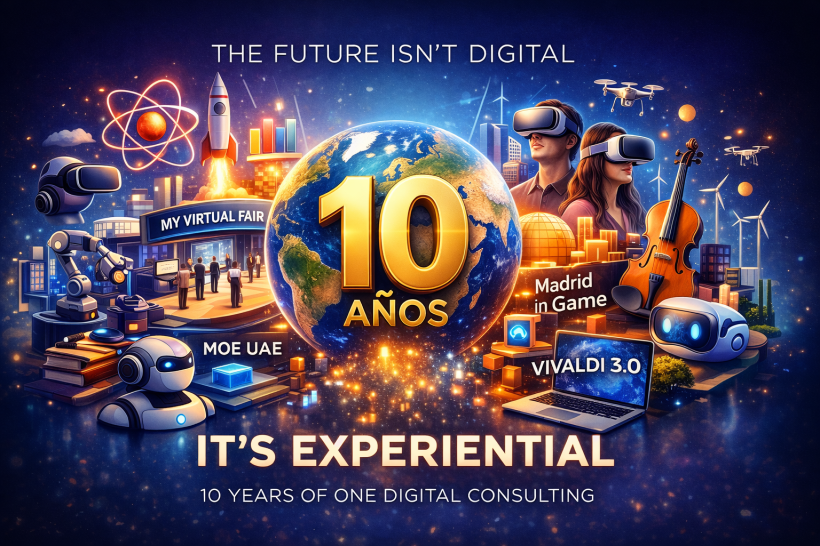
ONE Digital Consulting marks 10 years driving the shift toward the experiential economy

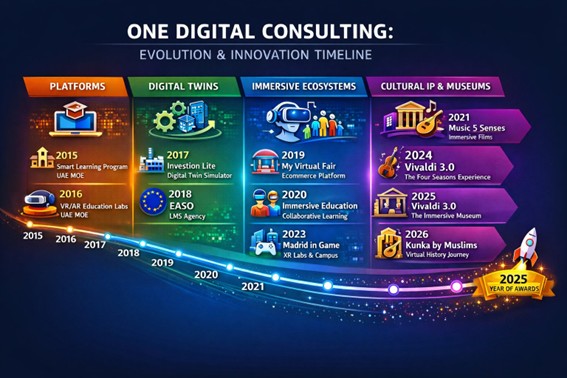
From immersive education in Spain, Italy, USA and UAE to virtual platforms and XR experiences, the company strengthens its international positioning across education, public sector, and immersive art and culture.

Abstract

Over the past ten years, ONE Digital Consulting has followed a path defined not just by technology, but by a deeper question: how can we transform the way people experience knowledge, culture, and connection? From immersive classrooms in the MOE UAE to virtual ecosystems for commerce and innovation, the journey reflects a shift beyond digital transformation toward something more human—the experiential economy. Projects such as My Virtual Fair, Madrid in Game, and the internationally recognized VIVALDI 3.0 illustrate a new paradigm where learning is lived, culture is felt, and interaction becomes immersive. This article is not just a reflection on a decade of work, but an exploration of what comes next. As the boundaries between physical and virtual worlds dissolve, the real challenge emerges: designing experiences that truly matter. Because the future is no longer something we simply access—it is something we experience.

Visionary approach

From digital transformation to lived experiences: a decade redefining how we learn, connect, and engage with the world.

ONE Digital Consulting celebrates its 10th anniversary as a key player in advanced technology solutions across education, public sector, industry, and culture, with a clear focus on the evolution toward the experiential economy.

Founded a decade ago, the company has led high-impact international projects such as the Smart Learning Program with the UAE Ministry of Education, where it developed and deployed 20 immersive laboratories equipped with VR, AR, and haptic technologies, redefining how students learn through experience.

It has also delivered learning platforms for European institutions such as the European Union Agency for Asylum (EASO), positioning itself as a strategic partner in complex digital transformation initiatives.

One of its flagship solutions is My Virtual Fair, a platform designed to activate and revitalize commercial ecosystems through immersive digital environments. It enables institutions and businesses to host interactive virtual fairs, combining real-time engagement, data analytics, and scalable formats that extend beyond physical limitations.

In Spain, ONE has contributed to Madrid in Game, an initiative led by the Madrid City Council, where it developed Immersive Labs—now considered a European benchmark—and the Virtual Campus for Entrepreneurship, a collaborative platform supporting startups through immersive learning and networking.

In the cultural space, VIVALDI 3.0 stands out as the company’s most awarded and internationally recognized project. This immersive experience combines classical music, sensory storytelling, and XR technologies to create a new way of experiencing culture.

After ten years, ONE Digital Consulting is focused on building solutions aligned with the experiential economy, where technologies such as XR and AI redefine how people learn, interact, and access knowledge.

The company highlights that the next decade will not be defined by digital transformation alone, but by experiential transformation, with direct applications in education, culture, professional training, and commerce.


The Future: Media That Is Experienced, Not Consumed

We are witnessing the emergence of a new category:

  • Immersive media
  • Experiential education
  • Interactive digital culture

At its core, ONE Digital Consulting is driven by a clear principle: technology must create real value for people.

In a world saturated with digital content, the focus has shifted from delivering information to designing meaningful experiences.

This means moving beyond passive consumption toward active engagement:

  • Museums will become explorable worlds
  • Learning will become an immersive experience
  • Culture and Arts will be felt, not just observed

This is not just a technological shift—it is a strategic one, aligned with the rise of the experiential economy.

The Great Opportunity — Collaboration as a Growth Engine

The question is no longer whether this transformation will happen. It is already happening.

The real questions are:

  • How do we design experiences that deliver real value?
  • How do we avoid repeating the mistakes of mass digitalization?
  • How do we put people—not technology—at the center?

Because the greatest risk is not technological. It is human.

Over the past decade, our progress has been built on strong partnerships and collaborative ecosystems.

Innovation rarely follows a straight path. It requires experimentation, adaptability, and the ability to move forward without predefined answers.

As Antonio Machado wrote: “Traveler, there is no path — the path is made by walking.”

This reflects our approach: building the future by creating it—step by step.

Conclusion

The next decade will not be defined by digital. It will be defined by experience.

And the organizations that understand this will not only be more innovative—They will be the ones that truly transform how we live, learn, and connect.


“The next decade will not be digital—it will be experiential. Our mission is to design technologies that don’t just deliver information, but transform how people learn, feel, and connect with knowledge.”

Carlos J. Ochoa Fernández ©

The Healing Power of Harmony: Enhancing Elder Well-being Through Classical Music and Virtual Reality

This article explores the therapeutic intersection of classical music and immersive virtual reality (VR) experiences for the elderly. Drawing from ongoing research and implementation in projects such as Music 5 Senses, Vivaldi 3.0 and The Immersive Music Planet, we present an evidence-based framework on how multisensory, music-driven VR can enhance cognitive function, emotional resilience, physical well-being, and social connectivity among older adults. This proposal outlines both scientific foundations and real-world applications that position immersive music as a powerful non-pharmacological intervention in elder care.

Abstract

This article explores the therapeutic intersection of classical music and immersive virtual reality (VR) experiences for the elderly. Drawing from ongoing research and implementation in projects such as Music 5 Senses, Vivaldi 3.0 and The Immersive Music Planet, we present an evidence-based framework on how multisensory, music-driven VR can enhance cognitive function, emotional resilience, physical well-being, and social connectivity among older adults. This proposal outlines both scientific foundations and real-world applications that position immersive music as a powerful non-pharmacological intervention in elder care.

Background & Rationale

In recent years, the aging population has become a focal point for innovation in healthcare, cognitive rehabilitation, and social inclusion. With global populations over 65 projected to double by 2050, the need for scalable, engaging, and empathetic solutions has never been greater. At ONE Digital Consulting, we have collaborated with Reina Sofía High School of Music, senior centers, and educational institutions to develop immersive projects that use classical music and XR (Extended Reality) to address these needs. Our flagship initiatives—Music 5 Senses, Vivaldi 3.0 and The Immersive Music Planet—are pioneering the use of multisensory, narrative-driven VR environments for the elderly.

Research-Driven Benefits

🧠 Cognitive Health

😌 Emotional & Psychological Resilience

🧍‍♂️ Physical Engagement & Rehabilitation

🗣️ Social & Cultural Enrichment

  • Shared VR concerts and musical journeys promote connection and conversation, combating isolation.
  • Users engage in immersive cultural exploration, reigniting curiosity and shared identity.
  • Studies: Aging & Mental Health, Virtual Reality & Culture

🩺 Therapeutic and Personalized Care

  • Personalized VR sessions allow users to experience familiar places and music, triggering emotional recall in Alzheimer’s therapy.
  • These memory journeys can be tailored to each user’s personal history and preferences for maximum impact.

Studies: Frontiers in Psychology, Music Therapy Perspectives

Innovation & Contribution

Our work bridges the gap between technology, culture, and elder care, creating a new digital therapeutic model rooted in sensory storytelling. Unlike standard music therapy or virtual tourism, we integrate cognitive neuroscience, classical music theory, and immersive design principles into one accessible platform.

These immersive experiences not only improve individual well-being but also redefine how we deliver care, culture, and community to our aging populations.

Call to Action & Next Steps

We seek to:

  • Publish these findings to raise awareness in scientific, educational, and health-tech communities.
  • Attract collaborators in geriatrics, music therapy, and XR development.
  • Engage with partners interested in scaling or piloting immersive music environments in senior care institutions across Europe and globally.

We believe this work is of interest to communities focused on:

  • Health Tech Innovation
  • Neuroscience and Geriatric Psychology
  • XR and Arts in Health
  • Digital Culture & Education
  • Human-Centered Design for Aging Societies

About the Author

Carlos Ochoa is an XR strategist and cultural technologist specializing in immersive education, digital storytelling, and arts-driven innovation. He leads ONE Digital Consulting, an award-winning company named Most Innovative XR in Education Company in Europe and recognized for its pioneering work in immersive music, VR well-being, and intergenerational learning.

#ImmersiveLearning Environments in Disruptive Advanced #Education #Ecosystems. Episode I.

“The world as we have created it is a process of our thinking. It cannot be changed without changing our thinking.” Albert Einstein.

Man is by nature a social animal. From birth, he absolutely needs others to develop physically and socially. Enhancing our intelligence in the face of our physical weakness. We are social creatures by nature and we need to learn how to be part of society, how to interact with groups of people, and how to work as a team. We are emotional, social, rational beings, with conscience and intentionality, will, freedom and personal identity, ethics…

“The world as we have created it is a process of our thinking. It cannot be changed without changing our thinking.” Albert Einstein.

Man is by nature a social animal. From birth, he absolutely needs others to develop physically and socially. Enhancing our intelligence in the face of our physical weakness. We are social creatures by nature and we need to learn how to be part of society, how to interact with groups of people, and how to work as a team. We are emotional, social, rational beings, with conscience and intentionality, will, freedom and personal identity, ethics…

We live in times of complete uncertainty. The world, had never faced a similar situation as we have today. Where there are too many questions in the air, still waiting for the correct answer, if there are any.

During this last months, I have got the perception that we were trying to hide ourselves into an increasingly virtualized world, behind decomposed avatars, robots or new small particles into a new virtual scenario as part of this new reality. Losing the control of our free brain activity, dominated for external unknown forces, as part of a live experiment drive by some kind of superior intelligence. But with some common feelings…the lack of affection, recognition, and human touch.

In this new world, governments face heedlessly to the new academic year, terrified of a new outbreak that will leave the system naked again, yes, let’s contribute something earthly. Let’s say things by their name, since, after several months of uncertainty, the capacity to anticipate, prepare for this new scenario has been nil and we continue to learn from the mistakes of the recent past.

There are no longer shortcuts, online paths traveled by elements devoid of the minimum preparation to face these new challenges in today’s society.

Today I lost my avatar, and I believe that there is only one possible path, towards the digital transformation in Education, from a completely disruptive and non-evolutionary approach. Since there is no time for it and these generations will not allow it.

Do we want to be remembered as responsible? Or guilty?

Episode I

Why do we want, need Immersive Learning Environments? Is it a new fad? is it a trend in education? does it really add value? is there proven evidence? Not it is not new, but what do we want it for.

  • Create immersive spaces in the image and likeness of real existing classroom spaces, but that adapt to different subjects.? Where classes are taught with immersive Caves / HDMI devices, etc.
  • Create a universal space, accessible by the entire educational community, both inside and outside the classroom, where to share experiences, activities, projects … etc.
  • Develop a learning methodology, where virtual spaces are recreated, with scenes adapted to the contexts and where students actively participate as members of the group. Customizing to your image and likeness? Future open worlds? Contributing your vision of the new virtual classroom?
  • Turn the classroom into an inspiring experience, each and every day of the year.? Are we ready for it?
  • Convert the workshops into creative, interactive and inspiring spaces, where students learn from good practices and develop their skills beyond their limitations?
  • Create multiverse spaces, where futuristic experiences are created, anticipating solutions to the world of the future? From the lessons learned from the past and through the use of new technologies? What would have become of … if we had acted …?
  • Imagine spaces that are transformed and adapted depending on the needs, the context, the problem … simulating unforeseen situations and seeing how the students react.
  • Learn from the silence, the stones, the walls, the art of the works hidden in the walls of history and understand the reason for the evolution of things, the need and the use of inventions … in contexts adapted to time.,

to be continue…

Have a nice and safe day.

Carlos J. Ochoa Fernández ©

VR Day in Madrid 2019

Carlos J. Ochoa, Co_Chair VRARA Education Committee. Madrid 23.11.2019

This weekend the Madrid VRAR Association participated in the VRDayMadrid 2019, within the “Virtual Reality World Day” framework. An event organized by xRWorldMadrid, an independent VR/AR group, sponsored by Everys, GreySkull and butic The New School and supported by VR/AR Association, Samsung, Talent Garden and RealoVirtual.

As one of the world’s referenced VR/AR live events, the VRDay draws industry experts from many verticals and enthusiasts from companies and universities to explore the latest advancements, knowledge and prototypes in VR/AR technology. During the complete Saturday, more than 200 attendants, 20+ speakers, 10+ exhibitors, 5 thematic round tables, 2 workshops and 2 masterclasses and an amazing demo zone with more than 10 VRAR experiences and a live performance, 2019 was the biggest year yet (according the organization).

The VRARA was represented by the Chapter President and Co_Chair of Education, Carlos J. Ochoa and 4 of our most relevant Spanish members and executives from: Seabery, Virtualware, participating in the Industry panel, Visyon presenting the Masterclass ElCano360 and ONE digital consulting in the Education and Training panel.

We were invited to participate in the Roundtable of VR in Education, to talk about future scenarios of “Training of Educators of the Future”. An excellent panel of experts with the participation of Chelu Martin from the IE Business School, Gonzalo Mariscal from XRLab of the European University, Carlos J. Ochoa of VR/AR Association and ONE Digital Consulting and the and moderated by Marco Antonio Fernández of Butic the New School .It was a very special opportunity to contrast the state of VR / AR in Education, from different points of view: University labs, teachers and industry. This allowed us contrasting realities materialized in ongoing projects, and new challenges that are drawn on a very attractive and exciting horizon.

We had the opportunity to present the Association Ecosystem and in particular, the activities of the Education Committee, the White Paper of VR in Education and the VR/AR in Education Survey.

I want to express my gratitude to the organization and their team, for the excellent work done hanging the “Sold Out” sign for several weeks before.

“Attending VRDayMadrid was a great opportunity to showcase the strength of the VR/AR ecosystem, and the incredible talent at work, case studies and projection from our members and share experiences and opportunities with other local companies and institutions.” Carlos J. Ochoa, President of the VRAR Association Madrid Chapter.

Media news: Real o Virtual

Carlos J. Ochoa Fernández ©

Empowering the teachers of today, for the citizens of the future

Carlos J. Ochoa, Co_Chair VRARA Education Committee. Piacenza (Italy) 24.09.2019

“The true sign of intelligence is not knowledge but imagination” A. Einstein

New technologies are an emerging industry creating employment opportunities and entrepreneurial possibilities. Virtual reality and augmented reality represent incredible areas of opportunity for future job skills. “VR” failed to live up to the wildest promises when the new VR systems launched in 2015. Nevertheless, the number of job postings for “VR and AR” have risen 93% since 2015, with 17% of that growth happening in the past year. 

According to projections set out by the European Commission, market demands for qualified information and communications technology (ICT) specialists will not be met, seeing a shortfall of up to 500,000 ICT professionals in 2020. Virtual and Augmented Reality solutions are amongst those with some of the highest market demand in the ICT sector by Marketwatch. The global market for augmented reality and virtual reality is estimated to reach USD 766 billion by 2025, registering a 73.7% CAGR during the forecast period of 2018 to 2025

New skills development for more complex jobs is a daily industry demand. Technicians and engineers need to be proficient and continue to change rapidly as tasks become more complex. They need to find the right information at the right moment. Technicians need fast access to all integrated data, to take fast, right and complex decisions.

Education is the driver to sustainability of our economy and functionality of humanity. Educating the individual is the country’s most valuable investment. It represents the foundation for progress and development. Every day we seek to learn new information and the way we take the lessons and apply to our everyday lives, is the core of how we explore we grow and we build futures for ourselves. 

If we wish to prepare a generation of citizens, entrepreneurs and leaders for the 21th. century who can face real-world problems, we must give them real-world problems to solve. Future jobs opportunities around VR/AR.

Through virtual and augmented realities, the technology allows the user to immerse themselves into a virtual experience or location and the immersive lesson is retained at a much quicker time frame with a more impactful lasting memory. VR & Learning, by the National Training Laboratory, advised retention rates for lecture style learning were at 5%, with reading rates at 10%. Meanwhile, the teaching method of VR scored a retention rate of 75%.

Understanding we are moving into a world with exponential growth, there is a necessary requirement to update our education system to support innovative technologies to understand how it will be applied to job creation and support digital support systems and processes.

The demand of the companies in the industry sector, with respect to their future workers, is that they have social skills and competencies such as leadership, motivation, perseverance, flexibility, communication, etc. Focusing on the development of skills and abilities aimed at a specific sector, in this case the Virtual Reality subsector ensures its better assimilation, greater effectiveness of training and a more complete response to what companies demand in profiles of these characteristics. For instance, in the Vocational Training includes subjects oriented to career guidance and orientation, but they lack a transversal skills development approach and these are not addressed directly in the itineraries.

The integration of transversal skills required for the sector, as well as technical competencies related to the latest trends, will comprehensively cover the labour market demands of new technologies and will ensure the best inclusion of VET students in the technological labour market of the future. The Future of Work by EAPN.EU.

It is time to take actions and introduce disruptive elements in our education system. Traditional methodologies and normalization already fail to provide rapid solution to the society needs. Velocity and acceleration are key factor for this unpredictable horizon, where education will play a key role for citizens of the future. Disruptive Innovation in Education?.

Humanity is at the beginning of a Fourth Industrial Revolution, which is building on both VR & AR applications and solutions. The changes to the way we teach, and the curriculum needed to support innovative time is required to support the graduating generations into a workforce rapidly changing and evolving using digital applications not yet taught in our schools’ systems. Day to day operations and day-to-day systems will be using VR and AR systems to be engaged in the operations.

VR & AR for Education is mandated for the following reasons:

  • To engage our current students and future generations in the Digital Age
  • To provide education of the tools, the technology, the applications of VR & AR to be used in future jobs
  • To provide best practices for the classrooms
  • To provide engagement tools for Students, Parents & resources for Teachers & Mentors
  • To be the leader and resource of VR & AR applications that relate to extending knowledge to support the application, build or creation of the technology to use in our everyday lives

At this moment, some relevant topics need to be include in the Disruptive School Environment and new teacher’s agenda for Schools of the Future:

  • Reimagining new Smart Spaces at schools
  • Classroom as a set of devices
  • 5 Senses learning a immersive learning technologies
  • Improve the hierarchy of needs in XR in Education
  • Convergence of technologies with and integrated vision
  • Soft skills integration with IT in the “Teachers Training Program”.
  • Collaboration Platforms. Virtual environments where the educational community can share best practices and experiences in a global and multicultural environment. Videos, presentations and forums integrate education materials from different sources in different formats.

It is in this context where Carlos J. Ochoa, Co_Chair of VR/AR Association Education Committee and Co-Founder of ICICLE ( X-Reality for Learning and Performance Augmentation, collaboration with Acer Education presented “Immersive Realities in Educational 4.0 Ecosystems” in the framework of Scuola e Virtuale in Piacenza.  Scuola e Virtuale, an international event along with Liceo Melchiorre Gioia, Impara Digitale, Indire and Microsoft, to spread awareness about immersive technologies in education, where more than 1000 professionals attendants ( teachers, students, managers and experts from different industries and sectors).

Carlos J. Ochoa Fernández ©

Best Practices in VR in Education. Chapter ONE

Throughout this year, I had the opportunity to write the “White Paper” of “Best practices in VR Education” for the prestigious international VR/AR Association, in collaboration with some reference members of the Education Committee and sponsored by ONE Digital Consulting and Vuze Cameras.

Throughout this year, I had the opportunity to write the “White Paper” of “Best practices in VR Education” for the prestigious international VR/AR Association, in collaboration with some reference members of the Education Committee and sponsored by ONE Digital Consulting and Vuze Cameras.


A reference document that aims to be support for managers, teachers, students and professionals who in one way or another are within the educational ecosystem. Throughout several chapters I analyze the status and evolution of the implementation of IT in Education, current technological trends and the benefits of Virtual Reality in Education today.


This document is only a small part of the entire work, which took me more than two years of study, analysis and editing. So I am in the revision phase of a second edition, much more complete and detailed, where I enter much more in depth and detail in the chapters of creation of immersive content, ecosystems, project orientation, experiential developments, levels of sensory perception and immersion and VR/AR ecosystems adapted to the different levels of education, as well as implementation methodologies and use cases.


This new version will be published throughout the month of June / July and will be presented exclusively at the Míranos y Únete in Madrid, where hundreds of teachers will take the opportunity to evaluate and participate in different live workshops.


Meanwhile, you can download the previous version in this link.


https://www.thevrara.com/blog2/2018/11/27/the-vrar-association-publishes-best-practices-for-vr-amp-ar-in-education


Any questions to this respect, I am at your disposal at carlos.ochoa@onedigitalconsulting.eu.


Good day and good luck.


Carlos J. Ochoa Fernandez (c)

Future Jobs Opportunities around VR/AR

Versatilist with Carlos Ochoa Fernandez Podcast.

New technologies are an emerging industry creating employment opportunities and entrepreneurial possibilities. Virtual reality and augmented reality represent incredible areas of opportunity. VR failed to live up to the wildest promises when the new VR systems launched in 2015. But the number of job postings for VR and AR have risen 93% since 2015, with 17% of that growth happening in the past year.

According to projections set out by the European Commission, market demands for qualified information and communications technology (ICT) specialists will not be met, seeing a shortfall of up to 500,000 ICT professionals in 2020. Virtual and Augmented Reality solutions are amongst those with some of the highest market demand in the ICT sector.

Education is the driver to sustainability of our economy and functionality of humanity. Every day we seek to learn new information and and the way we take the lessons and apply to our every day lives, is the core of how we explore we grow and we build futures for ourselves.

Through virtual and augmented realities, the technology allows the user to immerse themselves into a virtual experience or location and the immersive lesson is retained at a much quicker time frame with a more impactful lasting memory. VR & Learning, by the National Training Laboratory, advised retention rates for lecture style learning were at 5%, with reading rates at 10%. Meanwhile, the teaching method of VR scored a retention rate of 75%.

Understanding we are moving into a world with exponential growth, there is a necessary requirement to update our education system to support innovative technologies to understand how it will be applied to job creation and support digital support systems and processes.


It is in this context where Patrick O’Shea and myself, both from ILRN (Immersive Learning Research Network) and ICICLE ( X-Reality for Learning and Performance Augmentation, IEEE IC Industry Consortium on Learning Engineering) talk about Immersive Education around Cup of Coffee.

Thanks Patrick, for this amazing conversation.

Join the podcast here

Carlos J. Ochoa Fernádez ©

Impact and ROI of VR/AR in Training II

You asked the questions, and here are the answers.

Our Training Committee held a very successful webinar on “The Impact and ROI of VR/AR in Training” on 16th January 2019.

You can watch the Webinar recording here

You can also watch the solution demos here

It proved a popular event, with over 300 people registering to watch four enlightening presentations on very different Virtual Reality and Augmented Reality training applications. During the lively question-and-answer session it became clear that the number of great questions was larger than the time available to answer them all! This post allows the presenters to respond the questions that couldn’t be answered during the webinar.

Presenter 1 : David Trainor, Sentireal

Presentation Theme

David presented the “AppUccino” software, which delivers AR experiences for special-needs trainees to learn how to be a barista and work successfully in a commercial coffee shop. AppUccino directs trainees through the process of making americano, espresso, latte and cappuccino drinks. It generates AR overlays on the physical coffee-making equipment, including the industrial coffee machine itself, the separate coffee bean grinder and the separate water heater. A short video of part of the AppUccino AR experience can be seen here. Trainee performance measurements are taken as they prepare the drink using AppUccino and these measurements are uploaded to a cloud application, which analyzes them and presents training progress information to authorized training managers. An initial pilot with AppUccino indicated that trainees retained twice the amount of information and developed their skills 50% faster using AppUccino.

Webinar Questions for David Trainor

You said it took ~9 months of definition and dev, how many people were working on your team in which roles in order to accomplish this?

We used one media/content creator and one software developer. The work was carried out over the course of 9 months, but neither the content creation nor the software development role was full-time.

How were the analyses done? Observation? Performance against criteria on task?

The analyses were done based on (i) time taken for the trainee to perform certain tasks (ii) measurements of how accurately the trainee performed certain tasks and (iii) estimates of where the trainee’s attention and focus was at specific points in the procedure.

How many users has Appuccino had? What has been the impact? In how many months after development did you achieve that impact?

We’ve just completed an initial evaluation/pilot involving 15-20 trainees within a coffee shop managed by a partner training organization. At some point in February 2019 we intend to expand this to all barista trainees within that training organization.

How long did it take to create AR content for training?

The 3D models for the AR overlays were completed in approximately 1 week. The media is actually quite simple. Strong, simple content proved to be the best way to present the required information to special needs trainees who are affected by autism, Downs Syndrome or general learning difficulties. However we needed to spend much more time – about 4 months – on the instructional design and the directions, animations and transitions within the AR scenarios.

How did you already go about gathering data on ROI prior to the development (and also launch) of the app?

The data was gathered from a pilot study at one location. This was after the app was developed but before it was publicly released.

Very exciting project! Curious why you selected that small, unique demographic to start? Unique requirements? Expect to scale up to other populations?

We picked barista training as it’s an area where there is expected to be a lack of qualified employees in the future. In the UK, where I’m from, it is estimated that there is a shortfall of 40000 trained baristas. We selected special-needs barista trainees because there is a high degree of underemployment in that group and if we can create a good intuitive solution for special-needs trainees then it should scale up well to other groups and other types of catering or hospitality training applications.

Are these analytics published somewhere?

Not yet – the small pilot study that we’ve carried out gave us some indications on the training improvements and return on investment from AppUccino but we’re starting a larger evaluation in February 2019, when more trainees start to use the app at our partner training organization. We plan to publish the detailed outputs from this larger study.

Presenter 2 : Jeff Meador, Portico

Presentation Theme

Jeff presented Portico’s Diversity and Inclusion VR Seminar, which provides learners the opportunity to practice and master their skills with inclusive language. This program was designed to complement traditional classroom learning by preparing learners with practical applications of the skills discussed during classroom sessions. With Portico’s software, learners speak directly to AI-powered digital avatars and engage in simulated conversations that put their skills to test. Learners also get real-time feedback on their performance through a virtual trainer, who uses AI to guide users towards better language choices.

Webinar Questions for Jeff Meador

How did you factor in orientation to the VR experience to overcome novelty or unfamiliarity with the technology to get straight to the experience?
We didn’t want to rely on the learner having any previous experience with VR. We give users time to look around and explore prior to beginning the scenario. This gives them a chance to understand the parameters and boundaries of the exercise. We also engage in some light chit-chat (“how’s the weather” sort of stuff) to let the learner know that they are expected to talk and that the AI is listening and will respond.

Do you need a quiet room?

A quiet room certainly helps. Current speech-to-text technology is very strong, but having a quiet place for the training is very helpful. It also helps the learner concentrate on the task at hand.

Is Portico looking at including body language (proximity to client gestures, etc.)?

Yes; we’ve done some preliminary work with this and have set some behaviors that change based on the learner’s position and/ or focal point during the training.

How is the real time interaction happening? is it a sort of multiplayer training and a mentor is interacting with you? or the AI is giving you feedback?

Everything within our scenarios is driven by AI, including the feedback. Our goal is to have these role playing experiences run without the need for actors or facilitators.

Presenter 3 : Marlo Brooke, AVATAR Partners

Marlo presented a Mixed Reality Training System for aircraft and aircraft subsystem maintenance. Primarily an Augmented Reality / Mixed Reality solution, this high-fidelity, industrial-grade maintenance training system scales from a tabletop model design, to a full-sized aircraft, allowing the maintainer to train on the job, hands free, at the point of need, without any jitter or drift. The system utilizes object tracking (as opposed to stickers or markers) to ensure highly accurate lock on target, even as the user moves around the aircraft. It also  integrates to any backend system to both retrieve and record/send information about the maintenance task. It supports collaborative tasks and remote assistance.

Webinar Questions for Marlo Brooke

How did you come up with your pricing for your offerings?

Pricing is based on the specific requirement of the customer. AVATAR Partners can develop the application in its entirety, and/or the customer can purchase SimplifyXR to build/extend all or some of the functionality. Furthermore, because we use open source products such as Unity, the customer does not need to purchase SimplifyXR to extend any AVATAR Partners built XR solutions.

Is SimplifyXR proprietary to you or is it 3rd party?

SimplifyXR is is developed by AVATAR Partners using open source development tools, and can integrate to any backend system through APIs. It is licensed and sold through AVATAR Partners and its certified resellers. SimplifyXR is not required to extend any AVATAR Partner XR applications.

Could you please clarify how 97% reduction was calculated? Does it mean that instead of 100 hours of training without glasses only 3 hours with glasses are required?

You are correct. The training task was calculated based on the current training method for that particular wire failure, which involved an experienced maintainer gathering information from 3 different source materials (ETM, Wire Illuminator, and 2D schematics) to trace and identify the wire failure. The current training method is documented as taking 4 hours on average. The AR training experience is 7 minutes in duration, which is a 97% reduction in time to train.

Marlo, you said you have offices around the country.  I didn’t hear if Portico has the same, but do either of your companies look to establish satellite offices in more remote locations? If so, what type of environments do you look for? Developed workforce, local colleges, etc?

AVATAR Partners has regional offices in Huntington Beach CA, Arlington (Crystal City) VA, Virginia Beach VA, and Patuxent River MD, with personnel working in 8 different states within the USA. AVATAR has teaming partners with offices in Atlanta GA, Orlando FL, San DIego CA, Dayton OH, and Fort Worth, TX. We are expanding based on a variety of factors including the locations of teaming partners, certified resellers, and universities both within the USA and Allied Nations.

Marlo, how did you measure those analytics?

The performance metrics were derived from test results by AVATAR Partners based on the comparison of the current methodology versus the use of XR. These tests included accuracy,  time to train, and time to complete the task. Cost savings were derived based on an assumed reduction of errors based on increased accuracy, and will vary depending on the application and cost of parts. We also discussed other studies such as the Boeing/Iowa State Study on wing assembly (Interservice/Industry Training, Simulation, and Education Conference (I/ITSEC) 2014).

I’m not familiar with SimplifyXR — can you describe what that is and whether that is proprietary to AVATAR?

SimplifyXR is a software product developed by AVATAR Partners that allows non-programmers to develop their own Augmented Reality, Mixed Reality, and Virtual Reality experiences. It also speeds development time by tenfold by using a user-friendly interface. The product also evaluates the user’s desired XR application and notifies the user whether or not the application is well suited for XR, or if a different training media (e.g. video training) would be more effective. SimplifyXR is owned and licensed by AVATAR Partners, and is developed using open-source tools and industry standards, and also integrates to any backend system using APIs. The product is available directly through AVATAR Partners or certified resellers.

Was there a problem using AR on an object as large as an aircraft?

We overcame several challenges to make the solution commercially usable. Using the basic development tools and markers didn’t work – it caused significant drift, jitter and an inability to accurately track the object as the maintainer walked around the aircraft. AVATAR Partners was able to overcome all of these issues by developing algorithms to lock on target without any drift or jitter to the user. Our solution being hardware agnostic, we found the Microsoft Hololens and android tablet supported higher fidelity. Also, we used Mantis Vision 3D scanners to scan the aircraft, gaining an accurate 3D model so that we could use object tracking (instead of markers). This along with our programming algorithms provides the maintainer with absolute precision as they walk around the aircraft, regardless of the unit’s size (from 1:6 the model size, to full aircraft).

Presenter 4 : Carlos Ochoa, ONE digital consulting

Presentation Theme

Carlos presented XR platform for immersive training, operation and maintenance of industry plant services, eolic farms, which includes advanced reality technologies in 3d interactive environments (extended reality, 360º video and digital data integration), methodologies in a modular architecture (on/off line). Innvestion deploy an intelligent XR ecosystem with the specialized know-how to turn unstructured data into value-adding information, for specific subject when providing services such as preventive maintenance, security management or operational management. Simulation-based training, prefaced with traditional training methods on process fundamentals, is the most efficient and fastest way to train new employees and prepare them for their daily work providing huge added value and benefits.

ONE digital consulting has been working for more than 20 years in the eLearning and Training arena, and with our selected partners network in Europe, Saudi, India, Africa and Latam.

Webinar Questions for Carlos Ochoa

What hardware configurations are everyone on the panel currently using for their XR applications?

For a full INNVESTION experience, the user only needs a mobile device and VR glasses that fit the device. The training centre will need an internet connection to download different modules.

INNVESTION can be used in a single “low cost” VR environment based on Samsung Gear Mobile VR, through the most advanced VR Oculus Rift, HTC Vive configuration. The key issue of INNVESTION is data integration in one device. From reality to virtual reality or vice versa.

INNVESTION can be used in a multi window spheric environment, for multiuser training environments.

What are KPI’s?

The acronym KPI sounds for Key Performance Indicator. This is a general business term referring to any metric used in understanding how an organization is doing. While the term can be tossed around the business world ostentatiously or irrelevantly, the fundamental rationale derives from the simple concept that if you don’t know how you did in the past, you don’t know if you have improved in the future. Because every business has its own economic niche, customer acquisition models, geographic localities, production methods, etc., each business must define for themselves what makes them successful. Therefore, the “key” in KPI, should be a metric key to your enterprise. These indicators are as varied as your imagination, but a number of familiar indicators include monthly recurring revenue (MRR), cost to acquire a customer (CAC) and the term used in this webinar’s title, Return on Investment (ROI).

When you are looking to improve your ROI in your training strategy, you need to understand clearly the training savings metrics, saved commute hours, lifelong expense of your LMS solution, overall productivity and revenue increase, other factors specific to your business and training model.

In conclusion, we can see selected companies  transforming their business opportunities for the XR technology and adopt it regardless of cost and ‘clunkiness.’ Today we see leader enterprises utilizing XR for training, maintenance, engineering, and marketing purposes. These companies eventually pull everyone else in their direction as the industry caters to their operational needs and chases enterprise benefits.
VR/AR Education Committe Highlights 2018

With 2018 almost coming to a close, we’d love to highlight some facts and figures from the year and share all the different activities released from Education Committee.

This is the story of one year team work, reflections, sharing, experiences, meetings, failures, celebrating little wins and, for sure, growth.

We have just complete our first guides, case studies, life webinars and best practices white paper.

Sometimes I feel we made a heroic effort and starting reaching out to more and more people from all over the VR/AR Educational Community. We probably sent hundreds of emails, made the social media accounts, and talked with hundreds of people in last 12 months.

Last but not least, millions of people will use VR/AR technology in Education in the next coming years. I believe we are in a good starting point, demonstrating that VR/AR Edu Committee can be a powerful platform for teachers, students and professionals to speak out and bring light to the Future of Education.

We hope this roundup inspires you to engage into the VR/AR Edu Community.

With a little “big” help from my friends !!! Julie, Kris, Molly, Pradeep, Mfon, Kevin, Josue, Mike…and many more !!!

You can dowload the complete document here:

Carlos J. Ochoa Fernández ©

Transformando la Educación con Tecnologías Inmersivas. Parte 1ª.

Durante estos últimos tiempos, se está especulando mucho sobre si la Realidad Virtual será o no la nueva “killer app” en la Educación en un futuro inmediato.

Pero quizás el error comienza con la pregunta, que intenta llevarnos a un callejón sin salida ni sentido. No se trata sólo de Realidad Virtual o Aumentada. En la actualidad, podemos reconocer la Realidad Avanzada, como la convergencia de tecnologías inmersivas en donde además se integran otras tecnologías emergentes aportando un abanico de herramientas que permiten afrontar problemáticas y proyectos, con soluciones jamás antes imaginadas y mucho más próximas a la realidad. De esta manera, se puede “interconectar el mundo físico con el real”, creando un espacio digital interactivo, en donde desarrollar experiencias reales. O como dice el inventor de HoloLens Alex Kipman: el mundo de los átomos y el mundo de los bits

Si volvemos a la pregunta del inicio, vemos que esta pierde realmente el sentido desde la propia definición de estas tecnologías. Ya que no estamos hablando de aplicaciones, de dispositivos o de contenidos…Estamos hablando de una evolución de las tecnologías de la información, que revoluciona completamente la manera de interactuar con los ordenadores o las maquinas. Un nuevo ecosistema tecnológico y con nuevas metodologias a emplear.

Podemos decir sin ningúna duda, que es mucho más fácil aprender algo haciéndolo por nosotros mismos que siendo meros observadores, lectores o escuchando una lección. Por tanto, no resulta tan sorprendente que las tecnologías que te sumergen en escenarios inmersivos sean experiencias y acciones que se sientan dentro de ti de una manera natural, como tus propias experiencias y que sean un poderoso vehículo para entrenar varias habilidades y compartir conocimientos.

Por ello, y tal como he explicado en varios artículos anteriores, creo firmemente que el aprendizaje experiencial es el futuro de la educación.

Y de todo ello hablamos en la Feria de la Educación y en Aula 2018.

IMG_4849 (1)

Seguimos…

Carlos J. Ochoa Fernández ©