Learning in the Age of Intelligence: XR + AI as Drivers of Educational Evolution

The convergence between XR and AI is transforming education like never before. My latest report presents a strategic, evidence-based roadmap for responsibly integrating immersive technologies between 2025 and 2030. With the market projected to grow from $11.5 billion to $72.9 billion by 2030, the combination of more accessible hardware, creative AI, and experiential learning is building a more immersive—and more human—future for education.

The Augmented Campus: Designing Immersive, Responsible, and Measurable Education

The convergence between XR and AI is transforming education like never before. My latest report presents a strategic, evidence-based roadmap for responsibly integrating immersive technologies between 2025 and 2030. With the market projected to grow from $11.5 billion to $72.9 billion by 2030, the combination of more accessible hardware, creative AI, and experiential learning is building a more immersive—and more human—future for education.

This vision was reaffirmed at the Best of XR + AI Education Summit 2025 by the VR/AR Association, where over 30 international experts shared a common belief: the future of education must be inclusive, ethical, and sustainable—driven by technology that amplifies human talent and creativity, not replaces them.

The convergence of XR (VR/AR/MR) with generative and analytical AI is creating the first operating system for experiential learning.

This article outlines an ideal ecosystem—XR Labs, 3D simulators, 360° tours, Google Earth VR, digital twins, AI scenes, and persistent virtual worlds—accompanied by an actionable roadmap (0–36 months), a maturity model, a reference architecture, verifiable KPIs, and an implementation playbook validated through real projects by ONE Digital Consulting and SmartEducationLabs.


Vision: From the Classroom to the Augmented Campus

Education from 2025 to 2030 will be built on measurable, accessible, and secure immersive experiences, combining repetitive (simulator-based), situational (360° tours, Google Earth VR), and systemic (digital twins) learning.
AI plays three fundamental roles:

  1. Co-creation of content (scripts, assets, assessments)
  2. Pedagogical orchestration (adaptation, feedback, traceability via xAPI)
  3. Operational assistance (teacher support, headset MDM, accessibility QA)

XR + AI in Education 2030: Strategic Vision and Framework

Developed by Carlos J. Ochoa (ONE Digital Consulting & SmartEducationLabs), the report presents a strategic and practical vision for how the convergence of Extended Reality (XR)—encompassing VR, AR, and MR—and Artificial Intelligence (AI) will reshape education over the next decade.,

Its proposal integrates infrastructure, pedagogy, ethics, and data analytics into a coherent ecosystem designed for measurable, sustainable, and equitable outcomes.


1. A New Architecture for Learning

The model envisions a shift from the traditional classroom to the Augmented Campus—an environment where immersive practice and adaptive intelligence redefine how we learn. XR enables emotional, first-hand engagement with knowledge, while AI acts as co-creator, orchestrator, and evaluator, personalizing learning according to each student’s pace, style, and emotional state.

Key components of the ideal ecosystem include:

Learning Experiences

  • XR Labs (multidisciplinary): VR/AR stations with MDM control, safety zones, display casting, and session recording.
  • 3D Simulators: From soft skills (AI-driven role-play) to technical training (STEM, healthcare, vocational). Compatible with OpenXR and glTF/USDZ formats.
  • 360° Tours: Proprietary and licensed libraries, rapid authoring templates, mobile and headset accessibility.
  • Google Earth VR & Geospatial Learning: Projects on social sciences, history, climate, and biodiversity, enriched with AI-based data layers and storytelling.
  • Digital Twins: Virtual replicas of labs, campuses, or factories for real-time, situational, and what-if learning scenarios.
  • AI Scenes: AI-generated or expandable scenes with characters, branching narratives, and formative assessments.
  • Persistent Virtual Worlds: Hubs for classes, hackathons, science fairs, and inter-institutional collaborations with federated identities and spatial voice communication.

2. Evidence and Impact

Research shows a 10–20% increase in academic performance, a 25–40% reduction in mastery time, and a 30% improvement in retention compared to traditional methods.
Immersive learning also enhances empathy, inclusion, and soft skills—promoting a more human-centered, accessible approach to education.

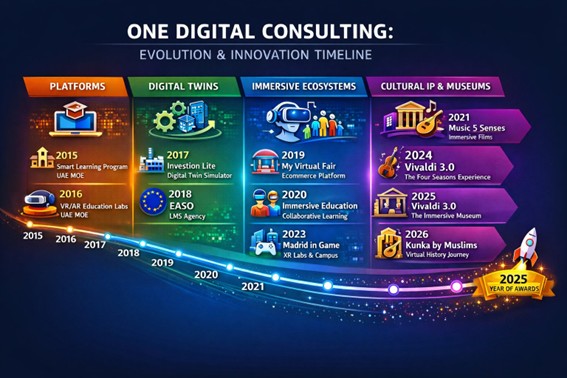
Flagship examples—such as XRLabs & SmartEducationProgram (UAE Ministry of Education), the XR Teachers Training Program (European Commission), Music and the Five Senses (Reina Sofia School of Music), Digital Twins for Vocational Training, The Immersive Universe of Vivaldi’s Four Seasons, and the Educational Metaverse for the Junta de Extremadura and AENOR—demonstrate XR’s proven effectiveness across STEM, industry, creative arts, and corporate training, achieving significant performance gains and cost reductions.


3. Roadmap to 2030

The report proposes a four-phase roadmap (0–36 months) to evolve from pilot projects to institutional transformation:

  1. Foundation (0–3 months): Create an XR committee, run initial pilots, and establish ethical guidelines.
  2. Integration (3–6 months): Connect XR systems to LMS, deploy XR Labs, and define first KPIs.
  3. Scaling (6–12 months): Embed XR into curricula, launch microcredentials, and deploy learning analytics.
  4. Consolidation (2–3 years): Implement campus-wide digital twins, build regional networks, and ensure financial sustainability.

This roadmap is supported by standardized metrics (learning, cost, wellbeing, accessibility) and an institutional maturity model (M0–M4) that tracks progress from isolated pilots to interconnected ecosystems.


4. Strategic Impact

The adoption of XR + AI drives a paradigm shift across multiple dimensions:

  • Pedagogical: From passive to experiential and emotional learning.
  • Economic: Reduced operational costs and expanded global access.
  • Social: Greater inclusion, universal accessibility, and sustainable development.
  • Ethical: Data protection, algorithmic transparency, and digital wellbeing.

Conclusion

The future of education depends not only on technology but on ethical and pedagogical integration.
When united under a solid governance model focused on human learning, XR and AI transform classrooms into living ecosystems of exploration, creativity, and collaboration.

ONE Digital Consulting invites institutions and governments to co-create this immersive, inclusive, and measurable educational future that will define the next decade.

📩 Contact the experts: madrid@onedigitalconsulting.eu

Carlos J. Ochoa Fernández ©

Embracing Creative Freedom: The Art of Experimentation in #XR

In the realm of #XR, there are still windows of unlimited possibilities waiting to be explored. As creators, we often find ourselves captivated by the allure of this immersive technology, eager to push the boundaries of our imagination.

In the realm of #XR, there are still windows of unlimited possibilities waiting to be explored. As creators, we often find ourselves captivated by the allure of this immersive technology, eager to push the boundaries of our imagination.

However, to truly harness the transformative power of XR, we must first grant ourselves the freedom to experiment without fear.

Experimentation is the cornerstone of creativity, serving as the catalyst for innovation and discovery. It is through experimentation that we uncover new techniques, refine our skills, and ultimately, forge new paths in the world of XR.

From my perspective and experience, it’s time to cast aside apprehensions and embrace experimentation wholeheartedly. “Experiment Freely” becomes a new mantra, an opportunity for creative liberation in the XR landscape. This mantra urges us to shed inhibitions, to break free from the chains of self-doubt, and to immerse ourselves fully in the vast array of creative possibilities that XR offers.

What can we understand by “Experiment Freely” in XR?

It means taking risks in experimentation, pushing beyond technological limitations and barriers, and using past learnings to explore, play, and innovate without restrictions. It means daring to dream big, challenging conventions, and exceeding expectations.

At the heart of this ethos lies a simple truth: the beauty of creative work lies in exploration, experimentation, collaboration, and empathy. It is through our willingness to push the boundaries of what is possible that we truly reach our full potential as creators. In the world of XR, this sentiment rings truer than ever.

Every new experiment is a learning opportunity, a chance to broaden our horizons and refine our art. With each new challenge, we come closer to mastering XR and unlocking its full potential for our creative careers. But this is just a fleeting step in a new direction, one that we cannot be certain where it leads, but it’s exciting.

Embracing uncertainty and venturing into the unknown is a risky and demanding path. A journey into the unknown alongside elements not necessarily prepared for this journey.

The world of XR awaits a new milestone yet to be discovered, ready to be shaped by our limitless imagination and unwavering determination. Let’s embark on a new journey, now.

You can visit some amazing references: #Music5Senses, #VIVALDI30, #MagicalandMysteryTour, and many more to come…

Carlos J. Ochoa Fernández ©

La Frágil Levedad del SER

Muerto el #Metaverso, larga vida a la #AI o #ChapGPT,  debiera decir?

En este mundo tan frágil, efímero e inconsistente en el que vivimos últimamente, resulta muy preocupante la fragilidad de los argumentos que soportan grandes decisiones de la vida diaria.

El duro mundo del influencer, del bloguero, del metaversado, en busca de la última novedad, o al menos así lo piensan ellos, los lleva a ensalzar ídolos y convertirlos en villanos en apenas unos meses. El poder del marketing, y su influencia en tomas de decisiones rápidas, en aquellos que actúan sin pensar (proactivos dicen ellos, desinformados, pienso yo) es realmente brutal. El numero de impactos en este breve espacio de tiempo, supera con creces las expectativas que se podría alcanzar por cualquier otro medio. Una caza sin piedad de desinformados, ignorantes habidos de ser, sin ser.

Nuevas generaciones que buscan respuestas rápidas a problemas complejos, sin importarles la consistencia ni la transcendencia de las decisiones o el alcance de estas.

¿Resultado? lo tenemos a la vista. El presente se nos cruza y abofetea cada día con temas tan trascendentes y relevantes como la canción de Shakira y las historias de Pique. Algo que no se produce como fruto de la casualidad, o ¿ piensas que si?.

Hoy a nadie le extraña que escritores, blogueros o revistas técnicas internacionales, lleven haciendo trampas con sus artículos firmados, y elaborados por una máquina. Por no hablar de grandes ídolos musicales de un solo tema, elaborados íntegramente por ordenador.

El nuevo “Tsunami” golpea nuestras desoladas costas de la educación. Aparecen nuevas voces en el horizonte, cantos de sirena, intentando convencernos de los milagros de la Inteligenia Artificial” y los chats inteligentes, bla, bla, bla.

En 1988, durante mi etapa de formación en la Escuela de Informática de Siemens en Alemania, llegó a mis manos un libro verdaderamente apasionante: Sistemas Expertos, editado por Siemens y Dieter Nebendahl. Se convirtió en mi libro de cabecera durante algún tiempo y apoyó los desarrollos que llevamos a cabo en los días de los Sistemas de Información Geográfica.

A lo largo de los últimos 5 años, como Co-Chair del Comité de Educación de la Asociación (VRARA), hemos venido realizando una incesante labor de sensibilización, liderazgo y colaboración, con instituciones de primer nivel, en el estudio de implementación de metodologías, tecnologías inmersivas en la educación, tratando de avanzar en el desarrollo de un nuevo ecosistema educativo.

Humildemente creo que, en muchas ocasiones nos hemos anticipado a los tiempos, elaborando trabajos y estudios: El estudio de la VR/AR en Educación, Immersive Learning, Adcanced Simulations, Virtual Worlds and Metaeducation, Augmented Education for Augmented Soceity

A lo largo de la interesante sesión de la semana pasada “Are we ready for #AI in #Education”, se pusieron de manifiesto por un importante panel de expertos internacionales, algunos puntos esenciales, como que uno de los propósitos centrales de la educación es desarrollar pensadores críticos. También que la educación se ve comprometida cuando tratamos de impartirla a grupos grandes. Y cuando la discusión se lleva a grupos pequeños es donde se logra el verdadero aprendizaje. Otro de los problemas que se pusieron encima de la mesa, es que estemos demasiado centrados en hacer trampa en algunos aspectos del desarrollo de nuestras habilidades, lo cual nos puede llevar a un triste escenario de futuros lideres, en donde la sociedad en su conjunto puede verse afectada. ¿Como vamos a permitirnos esta falta de integridad académica y su transcendencia en el desarrollo de los futuros lideres de esta sociedad?.

Es necesario poner el foco en incorporar el pensamiento crítico y el pensamiento basado en la aplicación en el sistema educativo con mayor peso, en lugar de escribir la información aprendida a través de libros (digital/papel) a los que se les puede dar un peso más bajo. En la actualidad podemos decir sin lugar a duda, que la perspectiva desde el punto de vista de los estudiantes, justo la opuesta.

Esto es, “Augmented Education” es un salto cualitativo, en donde metodologías y tecnologías inmersivas en entornos disruptivos, nos hacen visualizar y definir un espacio de educación y formación más práctica, colaborativa, avanzado, adaptado a las necesidades de la sociedad actual y futura. Centrándose en algo más práctico, innovador, basado en experiencias, trabajo colaborativo, etc… algo que está en el polo opuesto a la formación tradicional basada en la lectura, el aprendizaje escrito, etc…

Hace ya seis años, con motivo del congreso internacional #Expolearning, tuve la oportunidad de presentar: La rebelión de las máquinas y la formación disruptiva. Una visión futuristica de la Educación Inmersiva y Experiencial y su posible evolución…y parece que fué ayer.

Y en menos de tres semanas, es cuando aparece la novedad “para algunos” de herramientas como #ChatGPT. Y creen descubrir el nuevo santo grial, saltando inmediatamente a un nuevo futuro… olvidando todos los paradigmas, visiones y avances realizados en estos últimos años.

En realidad, estamos ante un escenario muy similar al inicio de la Robotica. Cuando empezaron a invadir nuestras vidas hace más de 50 años, con orígenes similares y en muchos casos paralelos a la IA… lástima que la memoria sea frágil, la ignorancia tan atrevida y el marketing de las grandes multinacionales tan potente. Alimentando la maquinaria paralela de los blogueros, que necesitan cada día para sus blogs novedades, noticias únicas, aunque no lo sean, y no se procuren de estudiar las cosas, su evolución, orígenes, etc…baste con copiar y traducir un artículo de una prestigiosa revista americana, y publicarlo como propio, o filtarlo por ChatGPT?.

Gracias a dios, no es el caso de los eruditos mortales, sino de los metaignorantes, que cada vez ocupan más la superficie de este maltratado planeta.

Es curioso ver cómo, año tras año, encaminados hacia la transformación digital en la educación, simuladores inmersivos, trabajo en equipo, herramientas avanzadas, mayor interactividad, realidad aumentada en tiempo real… alejándonos de libros, textos, mensajes literales, y apoyándose en el mundo gráfico e interactivo, y ahora…. we go back again?.

No tengo la bola de cristal, pero los tiempos están cambiando en una dirección, en la que necesitamos mas “Human Touch”, “Etica”, “Honestidad”, “Sentido de Sacrificio, del esfuerzo”, “Sentido Solidario” y “Educación en Valores”.

Estas de acuerdo?…y Tu, que piensas?.

Carlos J. Ochoa Fernández ©