A narrative review and policy-oriented framework for vocational resilience, immersive education, and labor-market alignment (2024–2025 evidence)
Abstract
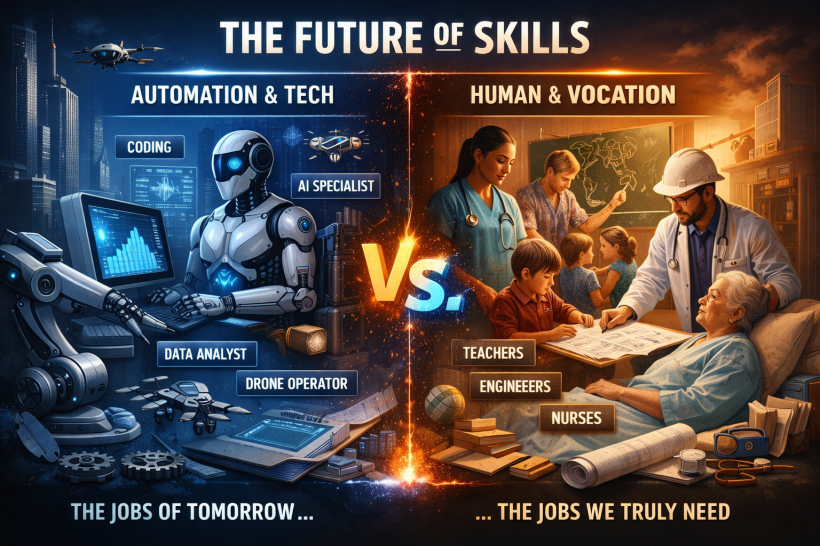
Public discourse on artificial intelligence (AI) and work often centers on job displacement and the future value of technical skills. However, recent European and global evidence indicates that many labor-market pressures stem less from automation than from persistent shortages in essential, vocation-driven professions (e.g., healthcare, education, engineering) and from skills mismatches.
This article synthesizes 2024–2025 evidence from the European Commission, Eurostat, the European Parliament, the OECD, Eurofound, the World Health Organization, and the World Economic Forum to (1) quantify demand signals in critical sectors, (2) distinguish “future skills” from “enduring societal skills,” and (3) propose immersive, experience-based education as a scalable mechanism to surface latent vocations and improve education-to-work transitions.
We argue that the most strategic response to AI-era disruption is not solely reskilling for technology, but redesigning education to cultivate vocational identity, ethical judgment, and systems thinking—capabilities that strengthen societal resilience across demographic change, healthcare strain, and infrastructure transitions.
Keywords: Artificial intelligence, workforce shortages, vocational education, immersive learning, XR, teacher shortages, healthcare workforce, skills mismatch, EU labor market, future of work.
1. Introduction
AI is accelerating task automation and reshaping occupational content. Yet the policy-relevant question is no longer only “which jobs will disappear,” but “which roles must reliably be staffed for society to function.” In the European Union (EU), labor and skills shortages are reported across all Member States, with employers indicating difficulty filling roles and the Commission identifying EU-wide shortage occupations.
This reframes “future skills” as a dual challenge: (a) technology fluency and adaptation, and (b) the cultivation of vocation-driven professions (health, education, engineering) where the binding constraint is often labor supply, working conditions, and training pathways rather than automation.
2. Method
This paper uses a narrative review approach, prioritizing 2024–2025 institutional sources and official statistical reporting: European Commission policy releases; Eurostat labor indicators; European Parliament briefings; OECD Education at a Glance 2024; Eurofound EWCS 2024 first findings; WHO workforce projections; and WEF Future of Jobs 2025. The goal is integrative synthesis (not meta-analysis), linking labor-demand signals to education design principles.
3. Evidence: Demand Signals and Skills Mismatches in Europe and Globally
3.1 EU-wide labor and skills shortages (systemic, not marginal)
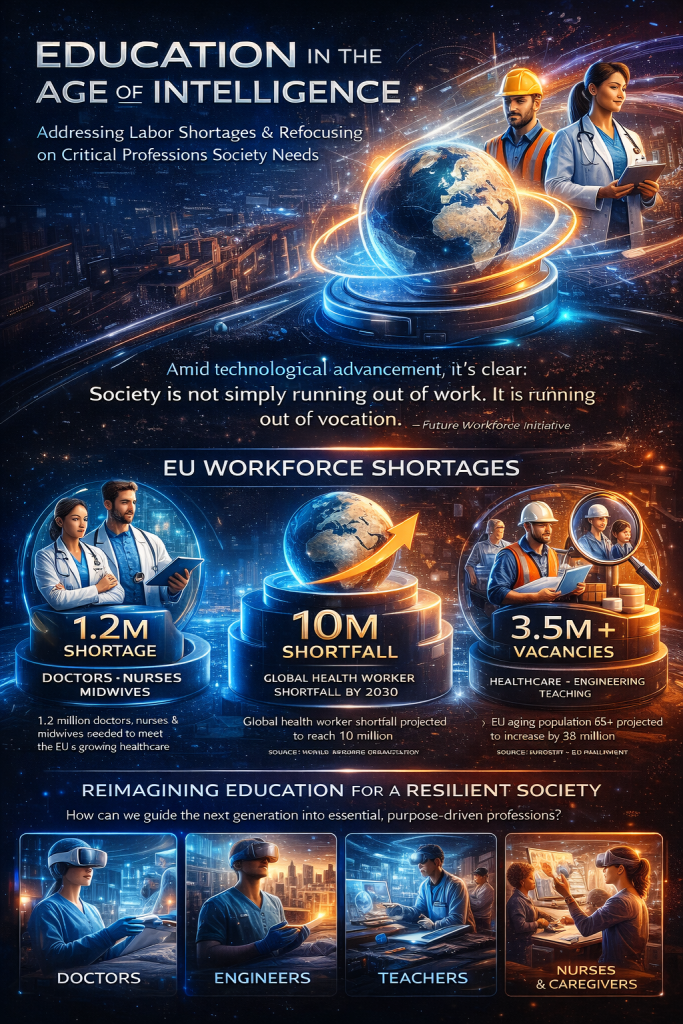
The European Commission reports shortages rising across all Member States, noting that 63% of SMEs in a cited survey cannot find the talent they need and that the Commission has identified 42 shortage occupations.
This indicates structural mismatches: vacancies persist even where overall employment is high.
3.2 Job vacancies as a measurable pressure indicator (Eurostat)
Eurostat’s job vacancy statistics provide the harmonized framework for tracking labor-market tightness and the distribution of vacancy pressures across sectors and time.
Eurostat’s euro indicators also report vacancy rates by economic activity (EU and euro area), supporting sector-level interpretation (e.g., where shortages concentrate).
3.3 Healthcare: the clearest case of “enduring societal demand”
EU health workforce shortages have been estimated at ~1.2 million doctors, nurses and midwives (as of 2022) in a European Parliament briefing referencing Health at a Glance: Europe 2024.
Globally, WHO reporting to its governing bodies indicates a projected shortage of ~11.1 million health workers by 2030 (with regional variation).
Complementary 2025 analysis also frames the expected global shortage as at least 10 million by 2030, emphasizing macroeconomic and health-burden implications.
Taken together, these sources support a robust range: ~10–11 million global shortfall by 2030, with the EU facing acute shortages as well.
3.4 Education: teacher shortages and system capacity
OECD’s Education at a Glance 2024 documents teacher workforce conditions and explicitly addresses where countries stand regarding shortages.
This matters because education systems are the pipeline for healthcare, engineering, and scientific capacity; teacher shortages can become a compounding constraint on future workforce supply.
3.5 Working conditions and retention: the “hidden” skills crisis
Eurofound’s EWCS 2024 first findings provide EU-wide evidence on job quality and working conditions—factors that strongly influence recruitment and retention in shortage sectors (notably health and care).
In practice, shortages often reflect not only training capacity, but also job quality, emotional demands, and sustainability of working lives.
4. Reframing the Skills Debate: “Future Skills” vs. “Enduring Societal Skills”
4.1 What employers say is rising (WEF 2025)
WEF’s Future of Jobs Report 2025 identifies skills increasing in importance through 2030, including AI and big data, analytical thinking, creative thinking, resilience/flexibility/agility, and technological literacy.
Notably, the “future skills” list is not purely technical; it elevates cognitive and socio-emotional capabilities.
4.2 Enduring societal skills (a functional definition)
This paper proposes “enduring societal skills” as capabilities that sustain essential services under demographic pressure, infrastructure transition, and systemic shocks:
- Clinical judgment, empathy, ethical decision-making (health and care)
- Pedagogy, mentorship, relational intelligence (education)
- Systems thinking, safety culture, design responsibility (engineering/infrastructure)
- Scientific reasoning, experimentation, uncertainty handling (research and innovation)
These are vocation-linked and inherently shaped by practice, context, and responsibility.
5. Why Immersive Education is Strategically Relevant
If the binding constraint is vocational supply and sustained motivation, education must support vocational discovery earlier and more vividly than traditional abstract instruction.
Immersive (XR) education can:
- Reduce abstraction by allowing learners to “enter” professional contexts (e.g., clinical simulations, engineering systems, lab environments).
- Strengthen vocational identity through situated experience (students can test-fit roles before commitment).
- Improve skills transfer by training perception-action loops (procedural and spatial reasoning), complementing conceptual learning.
- Support equity of access by bringing high-cost environments (operating rooms, labs) into schools.
Crucially, immersive learning should not be positioned as replacing teachers, but as increasing the bandwidth of teaching—especially relevant when teacher shortages strain system capacity.
6. Policy and Institutional Implications
6.1 Align education pathways with shortage intelligence
EU-wide shortage monitoring exists; educational planning should map curricula, capacity, and guidance systems directly to shortage occupations and regional demand.
6.2 Fund vocation-first immersive programs early
Given health workforce projections and EU shortages, early-stage exposure to healthcare and care professions is a high-leverage intervention.
6.3 Retention as a skills strategy
Shortage policy must treat job quality as part of the skills system; improving conditions stabilizes supply (Eurofound evidence supports the salience of job quality and sector-specific burdens).
7. Limitations
This is a narrative synthesis; it does not estimate causal impacts of immersive education on vocational entry or retention. Additionally, vacancy rates measure demand pressure but do not fully represent unmet societal need (which can be constrained by budgets, staffing ratios, and service design).
8. Conclusion
The AI-era skills agenda should be rebalanced: beyond preparing learners for digital tools, education must cultivate the vocations society cannot afford to undersupply. The evidence from 2024–2025 EU and global sources is consistent: shortages in health, education capacity constraints, and widespread employer-reported skills gaps indicate that the central challenge is not simply automation, but vocational resilience. Immersive education—implemented intentionally and aligned with shortage intelligence—offers a practical pathway to reveal hidden vocations and reconnect learning with real societal value.
In a world shaped by artificial intelligence, the most powerful investment is not smarter machines. It is inspired humans.
The future will not be defined by what AI can do. It will be defined by what we choose to become.
And the professions that will endure — doctors, nurses, engineers, educators, scientists — are not relics of the past. They are the backbone of the future.
If we want a resilient society, we must design education not around automation — but around vocation.
Because progress is not measured by efficiency alone.
It is measured by the people we prepare to lead it.
Statistical Reference Appendix (Selected Sources)
World Health Organization (2023). Global Strategy on Human Resources for Health.
World Economic Forum (2023). Future of Jobs Report.
OECD (2023). Education at a Glance.
European Parliament Briefings (2024–2025). Health Workforce Analysis.
Eurostat (2024). EU Job Vacancy Statistics.
United Nations (2022). World Population Prospects.
Global Infrastructure Hub (2022). Global Infrastructure Outlook.
International Labour Organization (2018). Care Work and Care Jobs for the Future of Decent Work.
European Commission. (2024, March 20). Tackling labour and skills shortages in the EU (Press release).
European Commission, Directorate-General for Employment, Social Affairs and Inclusion. (2024). Commission sets out actions to tackle labour and skills shortages (Newsroom item; includes action plan and factsheet links).
European Parliament Research Service. (2025). Healthcare in the EU shortages (At a glance briefing).
Eurofound. (2025). European Working Conditions Survey 2024: First findings (EF24026).
Eurostat. (2024/2025). Job vacancy statistics (Statistics Explained).
Eurostat. (2025). Euro area job vacancy rate… (Euro indicators, Q2 2025).
McKinsey Health Institute. (2025, May 14). Heartbeat of health: Reimagining the healthcare workforce of the future.
Carlos J. Ochoa Fernández ©

 Carlos J. Ochoa Fernandez